
Study abroad consultants operate in a highly competitive digital market. Students no longer depend only on recommendations or local offices when researching universities, countries and education opportunities. They search online, compare options, read blogs, watch videos and visit consultancy websites before deciding whom to contact.
This creates a major opportunity for SEO for study abroad consultants.
A strong SEO strategy can help a consultancy appear when potential students are actively searching for information related to studying abroad. Instead of paying for every website visitor through advertising, SEO can build a long-term source of organic traffic.
However, ranking a study abroad website is not simply about publishing more blogs.
The strategy needs to connect:
Keyword Research → Search Intent → Website Structure → Helpful Content → Technical SEO → Authority → Lead Conversion
What Is SEO for Study Abroad Consultants?
SEO, or Search Engine Optimization, is the process of improving a website so that search engines can understand its content and show it for relevant searches.
For study abroad consultants, SEO can target searches around:
- Study destinations
- Universities
- Courses
- Intakes
- Admission requirements
- Tuition fees
- Scholarships
- Visa information
- Application processes
- Career opportunities
For example, instead of targeting only a broad term such as:
“study abroad consultants”
a consultancy can build visibility around more specific searches such as:
- study abroad consultants for Canada
- UK university application requirements
- master’s in Germany requirements
- study in Australia after graduation
- MBA in France for international students
- study abroad scholarships
- September intake universities
The objective is to reach students at different stages of their decision-making journey.
 Why Organic Traffic Matters for Study Abroad Consultants
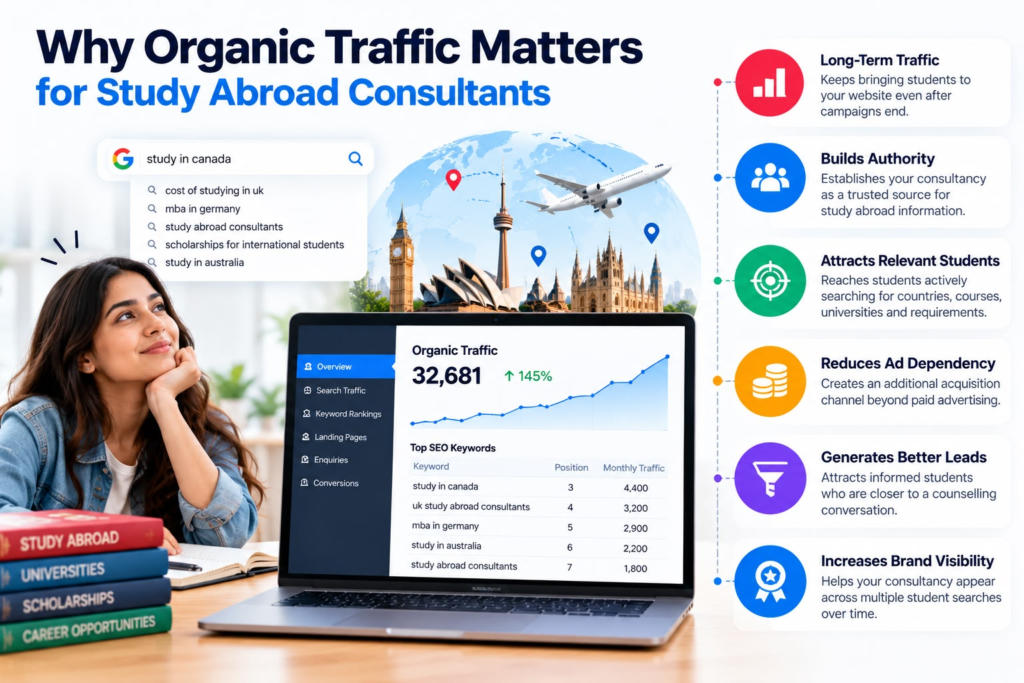
Paid advertising can generate immediate visibility, but SEO can create an additional acquisition channel that continues working after individual campaigns end.
A well-optimized article can attract visitors for months or even years when it continues to satisfy relevant search intent.
SEO can help study abroad consultants:
- Increase organic website traffic
- Build authority in specific destinations
- Attract students researching courses and universities
- Reduce dependency on paid acquisition
- Generate informational and high-intent leads
- Build long-term brand visibility
However, traffic itself is not the final objective.
The important question is:
Are the visitors relevant to your consultancy?
A website receiving thousands of visitors who have no intention of studying abroad may generate less business than a smaller website attracting highly relevant prospective students.
That is why keyword strategy is critical.
 How to Build an SEO Strategy for Study Abroad Consultants
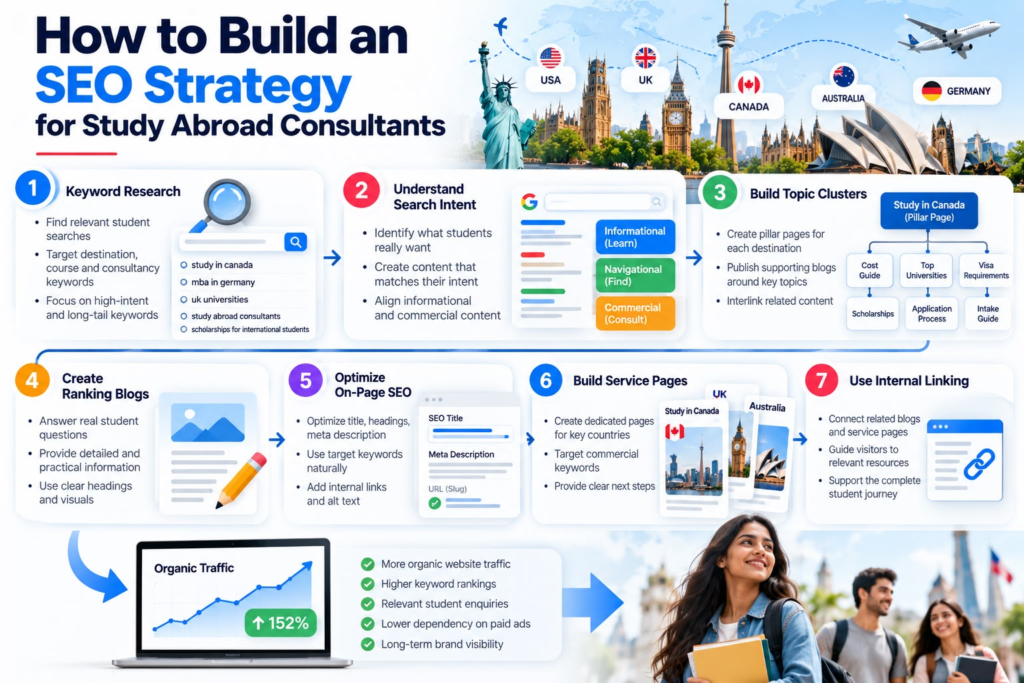
Start With Keyword Research
Keyword research should be the foundation of the SEO strategy.
Instead of randomly choosing topics, identify what prospective students are actually searching for.
A useful keyword strategy can be divided into different categories.
Destination keywords
Examples:
- study in Canada
- study in UK
- study in Australia
- study in Germany
- study in France
Course keywords
Examples:
- MBA in Canada
- master’s in UK
- engineering courses in Germany
- business courses in Australia
Information keywords
Examples:
- cost of studying in Canada
- UK student visa requirements
- scholarships for international students
- study abroad application process
Consultancy-intent keywords
Examples:
- study abroad consultants
- overseas education consultants
- Canada education consultants
- UK study abroad consultants
This gives the website multiple opportunities to appear across the student journey.
Understand Search Intent
Finding keywords is only the beginning.
The next question is:
What does the student actually want when searching that keyword?
For example:
“Cost of studying in Canada”
This is primarily an informational search.
The student wants information.
But:
“Canada study abroad consultants”
has a stronger commercial intent.
The student may already be looking for professional assistance.
Your content should match that intent.
A common SEO mistake is trying to force a sales message into every article. Informational searches usually require educational content first.
The commercial opportunity can come naturally through relevant internal links, resources and consultation pathways.
Build Topic Clusters
Instead of publishing unrelated blogs, create groups of content around important destinations, courses and student questions.
For example, a Canada Study Abroad topic cluster could contain:
Pillar Page:
Study in Canada: Complete Guide for International Students
Supporting Articles:
- Cost of Studying in Canada
- Best Courses to Study in Canada
- Canada University Application Process
- Canada Intake Guide
- Scholarships in Canada
- Student Visa Requirements
- Common Application Mistakes
These articles can link to one another.
This creates a stronger website structure and helps search engines understand the depth of the website’s coverage.
Create Ranking Blogs Around Real Student Questions
A study abroad blog should not exist simply because the website needs “fresh content.”
Every article should have a purpose.
Before writing a blog, ask:
What question is the student trying to answer?
For example:
Instead of:
“Canada Study Guide”
consider:
“How Much Does It Cost to Study in Canada?”
Instead of:
“UK Universities”
consider:
“How to Shortlist UK Universities Based on Your Profile”
Specific questions usually create clearer search intent and better content direction.
Optimize On-Page SEO
Once the topic is selected, optimize the page around the target keyword.
Important elements include:
- SEO title
- H1
- H2 and H3 structure
- Meta description
- URL
- Keyword placement
- Internal links
- Image alt text
- Content readability
- Relevant supporting keywords
The primary keyword should appear naturally.
Avoid repeating the same keyword unnecessarily.
The goal is to make the page useful for the reader first while making the topic clear to search engines.
Use Internal Linking Strategically
Internal linking is especially important for a study abroad consultancy because the website can contain many related topics.
For example, a blog about SEO can naturally connect to your broader lead-generation resources.
You can link readers to:
How to Generate High-Quality Study Abroad Leads Consistently
You can also connect SEO traffic with your nurturing strategy through:
The Ultimate Lead Nurturing Strategy for Study Abroad Consultants
If visitors are coming from organic search but do not convert immediately, retargeting can provide another opportunity to bring them back:
Retargeting Strategy for Study Abroad Leads
Internal linking should feel natural.
Do not add links simply to increase the number of links on a page.
The link should help the reader continue their research.
Create Service Pages for Commercial Keywords
Blogs are useful for informational searches, but study abroad consultants should not depend only on blog traffic.
Build dedicated service or destination pages for commercially valuable searches.
For example:
- Study Abroad Consultants
- Canada Study Abroad Consultants
- UK Study Abroad Consultants
- Australia Study Abroad Consultants
- University Application Assistance
- Student Visa Assistance
- Study Abroad Counselling
These pages should explain the service clearly and provide a relevant next step.
The blog attracts and educates.
The service page converts.
Turning Organic Traffic Into Study Abroad Leads
Create a Clear Conversion Path
Getting a visitor to your website is only the first step.
The website should guide the visitor toward an appropriate next action.
Depending on the page, that action could be:
- Download a guide
- Register for a webinar
- Submit an enquiry
- Request a profile evaluation
- Contact a counsellor
- Book a consultation
The conversion opportunity should match the visitor’s intent.
Someone reading an introductory guide may not be ready to book a consultation immediately.
Someone searching for a specific consultancy may be much closer to conversion.
Use Content to Build Trust Before the Sales Conversation
Study abroad is a high-consideration decision.
Students and parents may want evidence that the consultancy understands their situation.
Content can help demonstrate this expertise.
Useful content formats include:
- Destination guides
- University comparison articles
- Cost guides
- Application checklists
- Scholarship guides
- FAQs
- Student success stories
- Webinar content
- Admission guides
This creates multiple touchpoints before the student speaks with the sales or counselling team.
Combine SEO With Other Acquisition Channels
SEO should not operate in isolation.
A stronger strategy connects organic traffic with paid advertising, retargeting, social media, email and WhatsApp.
For example:
Google Search → Blog → Retargeting → Webinar → WhatsApp Follow-Up → Counselling
A student may discover the consultancy through an organic article but convert several weeks later after seeing a retargeting campaign or attending a webinar.
This is why the complete acquisition journey matters.
You can also explore:
Lead Sources of Study Abroad Consultants
Measure SEO Beyond Rankings
Ranking positions are useful, but rankings alone do not tell you whether SEO is generating business.
Track:
Organic Impressions → Clicks → Website Visits → Engagement → Enquiries → Counselling → Applications → Admissions
Important SEO metrics include:
- Organic clicks
- Organic impressions
- Click-through rate
- Keyword rankings
- Landing-page traffic
- Engaged sessions
- Enquiries
- Conversion rate
- Counselling bookings
- Applications
- Admissions
A keyword ranking on page one is valuable only when it contributes to meaningful business outcomes.
Common SEO Mistakes Study Abroad Consultants Should Avoid
Several SEO mistakes can limit organic growth.
Publishing blogs without keyword research
Writing frequently does not automatically create organic traffic.
Targeting only highly competitive keywords
A new website may struggle to rank immediately for extremely competitive terms. A combination of broader and long-tail keywords can create more realistic opportunities.
Creating duplicate destination content
Publishing nearly identical pages for different countries without meaningful differentiation can weaken the overall content strategy.
Ignoring search intent
A page can target the right keyword but still fail if it does not answer what the searcher actually wants.
Not connecting blogs to service pages
Informational traffic should have a logical path toward relevant commercial pages.
Measuring only traffic
Traffic without enquiries, applications or admissions can create a misleading picture of SEO performance.
Stopping after publishing
SEO requires ongoing optimization, internal linking, content updates and performance analysis.
 Build a Long-Term SEO Content Strategy
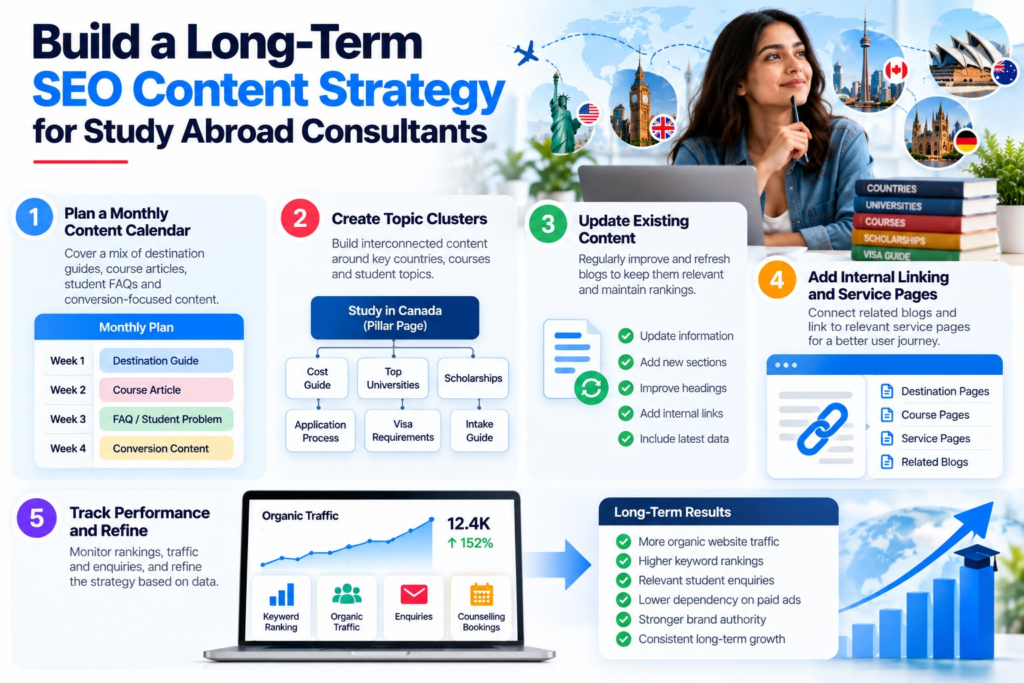
Create a Consistent Publishing System
SEO becomes more effective when content is planned instead of published randomly.
A monthly content calendar could include:
Week 1: Destination guide
Week 2: Course-related article
Week 3: Student problem/FAQ article
Week 4: Commercial or conversion-focused article
This creates a balanced content portfolio.
Update Existing Content
SEO is not only about creating new pages.
Existing articles can often be improved by:
- Updating outdated information
- Adding new sections
- Improving headings
- Adding internal links
- Improving meta titles
- Adding relevant FAQs
- Improving images and alt text
- Strengthening calls to action
Sometimes improving an existing page can be more valuable than publishing another similar article.
Build Authority Around Specific Study Abroad Niches
Instead of trying to rank for everything at once, identify the countries, courses and student segments that matter most to the consultancy.
Then build depth around those areas.
For example:
Country → Universities → Courses → Costs → Scholarships → Applications → Visa → Career Opportunities
This creates a connected content ecosystem.
Over time, the website can become a useful resource for students researching that destination.
Final Thoughts
SEO for study abroad consultants is not simply about getting more pages indexed or publishing a large number of blogs.
The real objective is to build a system that attracts the right students at the right stage of their decision-making journey.
The framework is:
Keyword Research → Search Intent → Useful Content → Internal Linking → Service Pages → Conversion → Nurturing
When SEO is connected with lead generation, retargeting, webinars and follow-up systems, organic traffic can become a valuable long-term acquisition channel.
The goal should not be:
“How many visitors did SEO generate?”
The better question is:
“How many relevant students did SEO move closer to counselling, application and admission?”
For a broader view of study abroad acquisition, explore Why Most Study Abroad Ads Fail and What Actually Drives Enrollments and How to Generate High-Quality Study Abroad Leads Consistently.
To learn more about Edigibrands’ solutions, visit Edigibrands or Contact Us.