
Introduction
Completing Class 12 can open several routes to higher education, including a bachelor’s degree in India or an undergraduate programme overseas. For students considering study abroad after 12th, the decision involves more than choosing a country. You need to match your academic stream, subjects, career interests, budget, English-language readiness and application timeline with the entry rules of individual universities.
There is no single admission rule that applies to every destination or institution. Some universities assess Indian Class 12 qualifications directly, while others may ask for specific subject combinations, entrance tests, a foundation programme or additional evidence. This guide explains the main options and gives Indian students a practical framework for shortlisting undergraduate courses abroad.
1. Why Consider Studying Abroad After Class 12?
A bachelor’s degree abroad can offer access to specialist programmes, international learning environments, research facilities, internships and different teaching approaches. Depending on the country and institution, students may also have opportunities to participate in co-op education, industry projects or exchange programmes.
These advantages are not automatic. Outcomes depend on the course, institution, academic performance, finances, student effort and rules that apply to international students. Compare the actual curriculum, accreditation, graduate outcomes and total cost instead of choosing a destination only because it is popular.
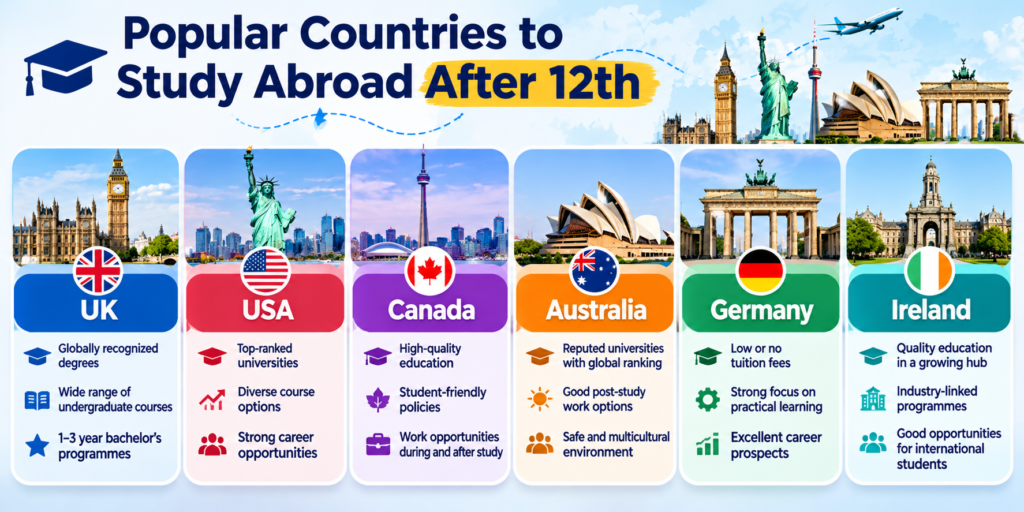 2. Popular Countries to Study Abroad After 12th
The countries below are common options for Indian students exploring undergraduate study. They are starting points for research, not a ranking. Course availability, qualification equivalency, fees, scholarships and visa rules vary by university and can change.
United States
What students may find: A wide range of majors, liberal-arts pathways, research universities and flexible options to explore subjects before confirming a major at some institutions.
Typical admission considerations: Class 12 transcripts and school records; programme-specific subject preparation; English proficiency; essays and recommendations where required. Some universities or programmes may consider SAT/ACT scores, while policies differ.
What to verify: Check each institution’s first-year international admission page, testing policy, financial-aid rules and total cost.
United Kingdom
What students may find: Three-year bachelor’s degrees are common in England, Wales and Northern Ireland; Scotland commonly has four-year undergraduate degrees. Specialist courses are available across many fields.
Typical admission considerations: Class 12 results may be accepted directly by some universities and courses; others may require particular marks, subjects, A-level equivalency, a foundation year or another pathway. English-language and course-specific requirements apply.
What to verify: Check exact course entry requirements and application route. Many undergraduate applications are made through UCAS, subject to course and applicant circumstances.
Canada
What students may find: A broad selection of university and college pathways, including bachelor’s degrees, applied programmes and co-op options at participating institutions.
Typical admission considerations: Recognised Class 12 qualification, required subject prerequisites and competitive grades. English-language evidence is commonly required unless an approved exemption applies.
What to verify: Review provincial and institution-specific requirements, programme prerequisites, deadlines and current study-permit guidance.
Australia
What students may find: Undergraduate degrees across business, engineering, IT, health, science, design and other disciplines; some institutions offer foundation or diploma pathways.
Typical admission considerations: Recognised senior-secondary qualification and required entry score or equivalent; subject prerequisites; English-language requirements; additional selection steps for certain courses.
What to verify: Check the university’s country-specific entry assessment and course page for minimum scores and prerequisite subjects.
Germany
What students may find: Potentially attractive for students interested in engineering, science, technology, business and other fields, with programmes taught in German and English.
Typical admission considerations: Eligibility depends on whether the Indian school-leaving qualification provides direct university entrance for the chosen course. Some students may need a preparatory route such as Studienkolleg and the required assessment. Language requirements depend on programme.
What to verify: Verify your exact qualification and subject combination through official German admissions guidance and the university. Do not assume every Indian Class 12 certificate gives direct entry.
Ireland
What students may find: Undergraduate options in computing, business, engineering, science, humanities, health-related fields and creative disciplines.
Typical admission considerations: Class 12 results assessed against institution and programme requirements; required subjects; English-language evidence; additional portfolio or selection requirements for some courses.
What to verify: Compare programme duration, tuition, living costs and the institution’s international entry criteria.
New Zealand
What students may find: Undergraduate study in business, agriculture, environmental science, engineering, IT, health and creative subjects.
Typical admission considerations: Recognised secondary qualification assessed against university entrance standards, course-specific academic prerequisites and English-language requirements.
What to verify: Check the university’s country-specific qualification guidance and current student-visa rules.
3. Undergraduate Courses Abroad: What Can You Study?
The right programme should connect your Class 12 subjects, interests, strengths and longer-term career plans. The examples below are broad categories; exact degree titles and entry prerequisites differ by institution.
FieldExample undergraduate coursesPossible subject considerationsEngineering and technologyMechanical, civil, electrical, computer, aerospace, mechatronics, software engineeringMathematics and often Physics; Chemistry may be required for selected courses.Computer science and ITComputer science, data science, cybersecurity, information systems, software developmentMathematics is required or strongly recommended by many universities; check coding or science prerequisites.Business and managementBusiness administration, finance, accounting, marketing, economics, international businessOften open to multiple streams; Mathematics may be required for economics, finance or quantitative routes.Health and life sciencesBiological sciences, biomedical science, public health, nursing and allied health fieldsBiology and/or Chemistry may be required; clinical programmes can have extra checks, placements or registration rules.Arts, humanities and social sciencesPsychology, sociology, media, politics, languages, history, international relationsSubject requirements vary; some programmes ask for relevant prior study, writing samples or interviews.Design and creative disciplinesGraphic design, animation, architecture, fashion, film, visual communicationA portfolio, audition, interview or creative task may be required.Hospitality and tourismHospitality management, tourism, event management, culinary artsRequirements vary; practical experience or interviews may be part of selected applications.
4. Admission After 12th: Common Eligibility Requirements
Universities assess applicants against both general entry standards and programme-specific conditions. Meeting a published minimum does not always guarantee admission, especially for competitive courses with limited places.
Recognised Class 12 qualification: Universities may assess CBSE, CISCE/ISC and state-board qualifications according to their own country and curriculum policies. Confirm that your board and certificate are recognised.
Academic marks and subject prerequisites: Required grades differ by university, course and applicant category. Engineering, computing, economics and science programmes may require specific Mathematics or science subjects.
English-language proficiency: Accepted evidence may include IELTS Academic, TOEFL iBT, PTE Academic, Cambridge English or another approved route. Minimum scores and component requirements differ. Some institutions consider prior English-medium education for an exemption, but it is not universal.
Entrance tests or aptitude assessments: Some universities or courses may consider SAT/ACT, admissions tests, portfolios, auditions, interviews or other assessments. Policies differ and may change by intake.
Personal statement and references: Some application systems or universities request a personal statement, essays, teacher references or recommendation letters.
Financial and immigration evidence: After admission, students generally need to follow the destination’s student-visa or study-permit process and provide required financial, identity and enrolment evidence. Admission does not guarantee a visa.
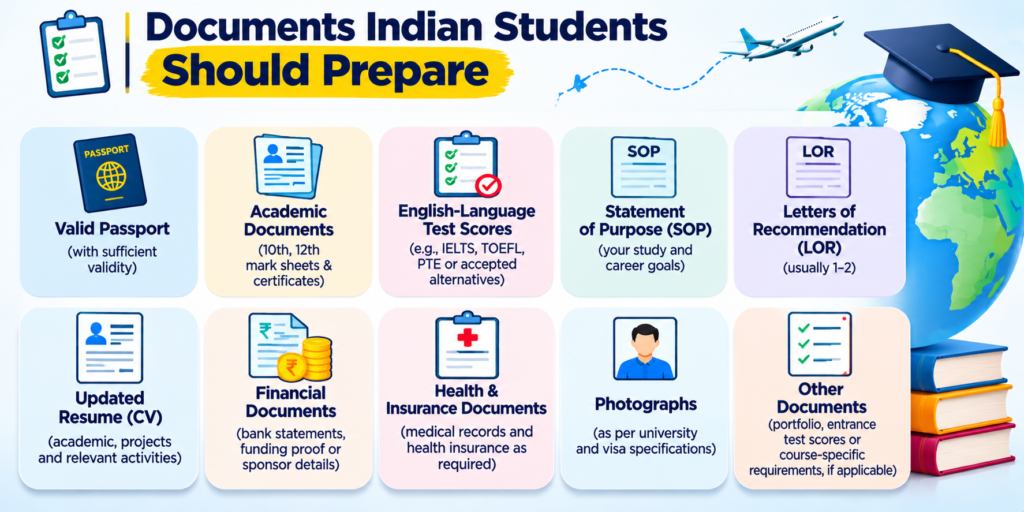 5. Documents Indian Students Should Prepare
Class 10 marksheet and certificate, where requested.
Class 11 and Class 12 transcripts or marksheets; predicted or interim grades if accepted.
Class 12 passing certificate or provisional certificate when available.
Passport and identity details.
English-language test result or approved evidence of exemption, if applicable.
Statement of purpose, personal statement or application essays, where required.
Letters of recommendation or referee details, where required.
Portfolio, audition material or supplementary documents for selected courses.
Financial documents for the visa stage, according to current destination rules.
Certified translations if any document is not in a language accepted by the institution.
6. How to Choose the Right Country and Course
Start with the career direction: Identify two or three subject areas you genuinely want to study. Do not select a course only because a country is trending.
Check subject eligibility: Compare your Class 12 stream and subjects with the exact prerequisites listed on each course page.
Shortlist institutions: Build a balanced list of ambitious, realistic and safer options. Check accreditation, curriculum, teaching facilities and graduate outcomes.
Calculate the full cost: Include tuition, accommodation, food, transport, insurance, deposits, travel and other living expenses. Check scholarship eligibility and intake restrictions.
Review application and visa timelines: Work backwards from the course start date. Allow time for tests, documents, decisions, deposits, visa processing and accommodation. Processing times vary.
Confirm details directly: Save the official course and admissions pages for every shortlisted option. If a requirement is unclear, contact the university’s admissions team in writing.
7. Application Timeline: When Should You Start?
A practical approach is to begin research 12–18 months before the intended course start where possible. This is a planning recommendation, not a universal deadline. Some courses have earlier deadlines, rolling admissions, portfolio dates or separate scholarship deadlines.
After receiving required enrolment documentsFollow the official visa or study-permit process, arrange accommodation and prepare for travel.
| Planning window | Suggested action | ||||||||
| 12–18 months before | Explore subjects and countries, check eligibility, estimate costs and create a shortlist. | ||||||||
| 9–12 months before | Prepare for English or entrance tests, arrange references and begin essays or portfolio work. | ||||||||
| 6–9 months before | Submit applications according to each university’s deadline and monitor requests for documents. | ||||||||
| 3–6 months before | Compare offers, review conditions, confirm funding and complete enrolment or deposit steps. | ||||||||
8. Common Mistakes to Avoid
Choosing a country before checking whether the preferred course is available and suitable.
Assuming the same Class 12 percentage is accepted by every university in a country.
Ignoring required subjects because the overall percentage looks strong.
Treating an English-test waiver at one university as a waiver everywhere.
Assuming all universities accept the same English tests or minimum scores.
Relying on old deadline lists instead of the current official course page.
Budgeting only for tuition and overlooking living costs, deposits, insurance and travel.
Assuming an offer letter guarantees a student visa or study permit.
Submitting generic personal statements that do not explain course fit and motivation.
9. Direct Entry vs Foundation Pathway
Direct entry may be possible when your Class 12 qualification, marks and subject combination meet the university’s requirements. A foundation programme or other preparatory route may be considered when the university does not regard your current qualification as sufficient for direct entry, when you need additional subject preparation, or when the institution offers a structured progression route.
Do not assume a foundation course guarantees progression to a bachelor’s degree. Before paying a deposit, check progression conditions, required grades, course recognition, total duration, total cost and whether progression is guaranteed or competitive.
10. Frequently Asked Questions
Can I study abroad after 12th from a state board?
Many universities assess recognised Indian state-board qualifications, but acceptance and required marks are institution- and course-specific. Check the university’s country-specific entry page.
Can I study abroad after 12th without IELTS?
Some institutions accept other English tests, prior English-medium study or approved exemptions. Policies differ, and an exemption from an English test does not remove all academic or immigration requirements. Confirm the exact policy with the university and relevant visa authority.
Which stream is required for undergraduate courses abroad?
It depends on the course. Engineering and many science programmes commonly require Mathematics and/or science subjects. Business, humanities and creative programmes may accept a wider range of school backgrounds, subject to course rules.
What percentage is required for admission after 12th?
There is no universal percentage. Entry standards vary by country, university, course, board and competition for places. Use the official course-specific requirement rather than a generic percentage claim.
Can I apply before my Class 12 results are declared?
Some universities consider predicted, interim or mid-year grades and may issue conditional offers. You must later provide final results and meet offer conditions. Not all institutions or programmes use this process.
Are scholarships available for students applying after Class 12?
Some universities and external organisations offer scholarships to international undergraduate applicants. Eligibility, award value, deadlines and renewal conditions vary. Check whether the award is open to Indian students and whether a separate application is required.
Does admission guarantee a student visa?
No. Admission and immigration decisions are separate. You must meet the destination’s current visa or study-permit requirements, including financial and documentation rules.
Conclusion
Planning to study abroad after 12th is a major academic and financial decision. The strongest application starts with a suitable course, verified eligibility, a realistic budget and enough time to prepare accurate documents. Compare institutions rather than relying on country-level assumptions, and confirm every important requirement on the official university and immigration websites before applying.
Suggested EdigiBrands Internal Links
Add these links only where they genuinely support the paragraph. Replace the IELTS article URL below with its exact published URL if it differs from the homepage supplied in the brief.
Study Abroad Without IELTS: Countries and University Options — https://www.edigibrands.com/
EdigiBrands EdTech Product — https://www.edigibrands.com/edtech-product/
About EdigiBrands — https://www.edigibrands.com/about/
Contact EdigiBrands — https://www.edigibrands.com/contact-us/
Book a Consultation — https://www.edigibrands.com/calendly/
Official External Sources for Fact-Checking
University of British Columbia – Admission requirements: https://you.ubc.ca/applying-ubc/requirements/
University of Toronto – High school requirements by country: https://future.utoronto.ca/high-school-requirements-country
University of Alberta – International admission requirements: https://www.ualberta.ca/en/admissions/how-to-apply/international-admission-requirements/index.html
University of Melbourne – Undergraduate entry requirements: https://study.unimelb.edu.au/how-to-apply/undergraduate-study/international-applications/entry-requirements
University of Guelph – International undergraduate requirements: https://www.uoguelph.ca/admission/undergraduate/international/requirements