
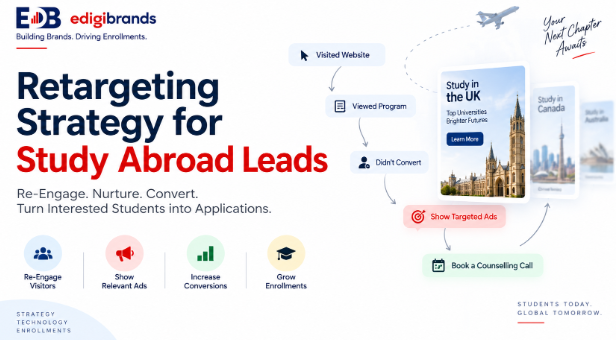
Retargeting Strategy for Study Abroad Leads: How to Re-Engage Students and Increase Conversions
Generating a study abroad lead is only the beginning of the student acquisition journey. Many students who click an advertisement, visit a consultancy website, download a guide, or submit an inquiry form are not ready to book a counselling session immediately.
They may be comparing countries, checking university options, discussing finances with their parents, researching visa requirements, or simply waiting for the right time to take the next step.
This is where retargeting becomes an important part of a study abroad marketing strategy.
Instead of continuously spending money to find new students, retargeting allows study abroad consultants to reconnect with people who have already interacted with their brand. The objective is not simply to show the same advertisement again. It is to understand what the student has already done and then give them a relevant reason to continue the conversation.
In this guide, we will explore how study abroad consultants can build a practical retargeting strategy, segment their audiences, create better remarketing campaigns, and move potential students closer to counselling and applications.
What Is Retargeting for Study Abroad Leads?
Retargeting is the process of showing relevant advertisements to people who have already interacted with your business.
For a study abroad consultancy, this could include:
- A student who visited your website
- Someone who viewed a course or country page
- A person who interacted with your Instagram or Facebook content
- Someone who watched your YouTube video
- A student who opened a lead form but did not submit it
- Someone who downloaded a study abroad guide
- A previous inquiry that did not book counselling
- A student who submitted an inquiry but has not started an application
The important point is that these people are not completely cold audiences.
They already know something about your consultancy.
That gives you an opportunity to continue the conversation instead of starting from zero.
If you are still building your overall lead-generation system, understanding how to generate high-quality study abroad leads consistently is a useful starting point before building a retargeting layer.
Why Study Abroad Leads Often Need Multiple Touchpoints
Studying abroad is not an impulse purchase.
A student may need to consider:
- Country
- University
- Course
- Tuition fees
- Living expenses
- Scholarships
- English-language requirements
- Visa requirements
- Career opportunities
- Family approval
- Financial planning
- Intake deadlines
Because the decision involves multiple factors, a student may interact with your brand several times before becoming ready for counselling.
For example:
Day 1: Student sees a Meta advertisement.
Day 2: Student visits your website.
Day 5: Student watches a university comparison video.
Day 8: Student checks the cost of studying abroad.
Day 12: Student sees a retargeting advertisement.
Day 15: Student downloads a country guide.
Day 18: Student books a counselling call.
This is why a single advertising campaign should not be expected to handle the entire student journey.
Your retargeting strategy should help bridge the gap between initial interest and meaningful action.
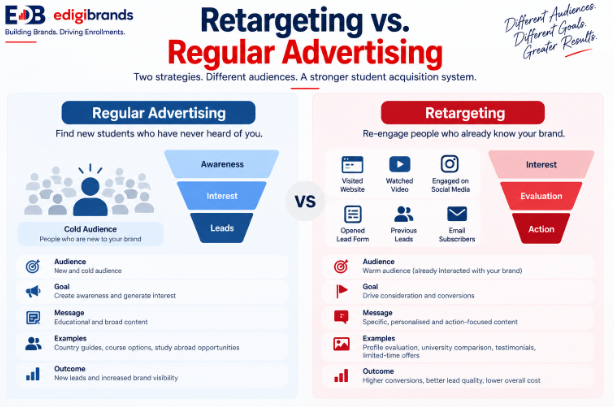
Retargeting vs. Regular Advertising
One of the biggest differences between prospecting and retargeting is the audience’s familiarity with your brand.
Cold Audience
These students may have never heard of your consultancy.
Your objective is to create:
Awareness → Interest
Your messaging could focus on:
- Study destinations
- Popular courses
- Career opportunities
- Country guides
- Educational content
Retargeting Audience
These students already know something about you.
Your objective becomes:
Interest → Evaluation → Action
Your messaging can therefore become more specific.
For example:
“Still comparing UK and Canada for your Master’s?”
or
“Not sure which universities match your profile?”
The advertisement is no longer simply introducing your consultancy. It is addressing the next question in the student’s journey.
The First Step: Build Your Retargeting Audience
A strong retargeting campaign starts with audience segmentation.
Do not put every website visitor and social media user into one large audience.
Different interactions represent different levels of intent.
1. Website Visitors
Create an audience of people who visited your website within a specific period.
For example:
- Last 7 days
- Last 14 days
- Last 30 days
- Last 60 days
- Last 90 days
Someone who visited yesterday may require different messaging from someone who visited three months ago.
2. High-Intent Page Visitors
Not every website visitor has the same level of interest.
Someone who visits your homepage may simply be exploring.
Someone who spends time on:
- UK study pages
- Canada study pages
- MBA pages
- University pages
- Application pages
- Contact pages
may demonstrate stronger intent.
These audiences can receive more specific advertisements.
3. Social Media Engagers
Your social media audience can become an important retargeting pool.
Consider users who:
- Watched your videos
- Engaged with posts
- Saved content
- Shared content
- Visited your profile
- Interacted with advertisements
Instead of repeatedly showing awareness content, move these people toward deeper educational content.
For example:
First interaction:
“Top reasons students choose Germany.”
Retargeting:
“Is Germany actually suitable for your academic profile?”
This creates a natural progression.
4. Video Viewers
Video engagement can be particularly useful because the amount of video watched can indicate different levels of interest.
You can create audiences around:
- 25% video viewers
- 50% video viewers
- 75% video viewers
- 95% video viewers
Someone who watched almost an entire university comparison video has demonstrated a different level of engagement from someone who watched only a few seconds.
This allows you to create more relevant messaging.
5. Lead Form Openers
Some students may open your lead form but never submit it.
These users should not necessarily be treated like completely new prospects.
You can retarget them with messaging focused on reducing friction.
For example:
“Still exploring your study abroad options? Get a profile evaluation before choosing your destination.”
The objective is to give them another reason to complete the action.
6. Previous Leads
Your CRM can become an extremely valuable source of retargeting audiences.
Previous leads can include:
- Not responding
- Follow-up required
- Interested
- Future intake
- Application pending
- Counselling completed
- Documents pending
Each group can require a different communication strategy.
For example, someone planning for a future intake should not receive the same advertisement as someone who has already submitted documents.
This is where retargeting becomes connected to your lead management system, rather than functioning as an isolated advertising activity.
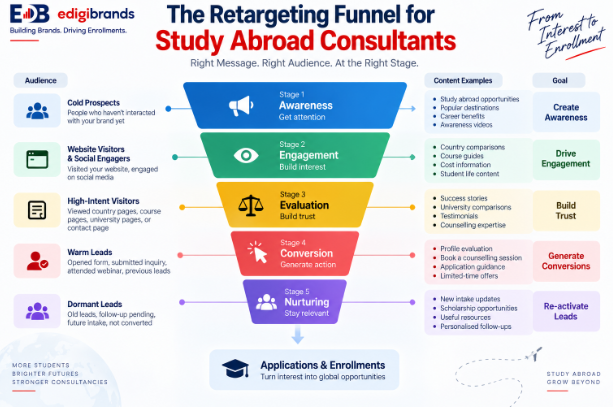
The Retargeting Funnel for Study Abroad Consultants
A simple retargeting funnel can look like this:
Stage 1 — Awareness
Audience: Cold prospects
Goal: Get attention
Content:
Country guides, courses, study abroad opportunities
↓
Stage 2 — Engagement
Audience: Website visitors and social engagers
Goal: Build interest
Content:
Comparison content, student stories, university information
↓
Stage 3 — Evaluation
Audience: High-intent visitors
Goal: Build trust
Content:
Success stories, testimonials, counselling expertise, profile evaluation
↓
Stage 4 — Conversion
Audience: Warm leads
Goal: Generate action
Content:
Counselling booking, profile evaluation, application consultation
↓
Stage 5 — Nurturing
Audience: Leads who have not converted
Goal: Stay relevant
Content:
Email, WhatsApp, educational content and targeted remarketing
This structure is more useful than simply running the same advertisement repeatedly.
What Should You Show in Retargeting Ads?
The biggest mistake in remarketing is showing the same message to everyone.
If a student has already seen your “Study in Canada” advertisement five times, showing it again does not necessarily give them a new reason to act.
Instead, change the message according to their stage.
Content Type 1: Educational Retargeting
Use educational content when the student is still researching.
Examples:
- “5 Things to Check Before Choosing a University”
- “UK vs Canada: Which Is Better for Your Course?”
- “How Much Does Studying Abroad Actually Cost?”
- “What IELTS Score Do You Need?”
The objective is to remove uncertainty.
Content Type 2: Comparison Content
Students often compare options before contacting a consultant.
Create advertisements around:
- Country vs country
- University vs university
- Course vs course
- Tuition comparison
- Cost-of-living comparison
- Career opportunity comparison
This type of content can bring students deeper into the evaluation stage.
Content Type 3: Social Proof
Students want confidence before choosing a consultancy.
Use:
- Student success stories
- Testimonials
- Application journeys
- University admits
- Counselling experiences
- Case studies
Instead of simply saying:
“We are the best consultancy.”
Show evidence that helps students understand your experience.
This connects directly with the broader issue discussed in why students don’t choose a consultancy even when the consultancy is good.
Content Type 4: Objection-Based Retargeting
A student may not convert because they have an unanswered question.
Common objections include:
- “Is this country affordable?”
- “Will I get admission?”
- “Which university should I choose?”
- “Can I get a scholarship?”
- “What happens if my visa is rejected?”
- “Do I need IELTS?”
- “Is this course suitable for my profile?”
Instead of pushing a sales message, create content that answers these questions.
This helps move the student from uncertainty toward evaluation.
Content Type 5: Conversion Ads
Once a student has consumed enough information, you can introduce a stronger call to action.
Examples:
Get Your Profile Evaluated
Book a Counselling Session
Check Your University Options
Speak With a Study Abroad Expert
The CTA should match the level of intent.
A cold audience may not be ready for a consultation.
A student who has visited your application page multiple times may be.
The Importance of Audience Exclusions
Retargeting is not only about deciding who to target.
You also need to decide who not to target.
For example, if someone has already completed an application, they may not need to continue seeing an advertisement asking them to start an application.
Similarly, students who have already booked counselling should be moved into a different communication sequence.
Consider excluding:
- Converted leads
- Existing applicants
- Students who completed the desired action
- Irrelevant audiences
- Duplicate lead audiences
This reduces unnecessary advertising exposure and helps keep campaigns cleaner.
How Long Should You Retarget a Student?
There is no single retargeting window that works for every consultancy.
A practical approach is to create multiple windows.
0–7 Days
Focus on recent intent.
Content:
- Profile evaluation
- Counselling
- Immediate next steps
8–30 Days
Focus on education and trust.
Content:
- Comparisons
- Student success stories
- FAQs
- University guides
31–90 Days
Focus on longer-term nurturing.
Content:
- Intake information
- Country guides
- Cost planning
- Scholarships
- New webinars
The important factor is to match the communication with the student’s likely stage rather than simply increasing ad frequency.
Retargeting Frequency Matters
A retargeting campaign can quickly become repetitive.
If the same person sees the same advertisement repeatedly, the campaign may lose effectiveness.
Monitor:
- Frequency
- CTR
- CPC
- Landing-page engagement
- Lead conversion
- Cost per lead
- Cost per qualified lead
If frequency increases while engagement declines, consider:
- New creatives
- New messaging
- New audience segmentation
- Different content formats
- Different offers
Retargeting should feel like a continuation of the conversation, not repetition.
Connect Retargeting With Your Landing Page
Your advertisement and landing page should tell the same story.
For example:
Ad:
“Not sure whether Canada is right for your profile?”
Landing Page:
“Get a personalized Canada study profile evaluation.”
The transition should be natural.
A disconnected landing page can create friction even when the advertisement is performing well.
For more on this, see our guide to landing page strategy for study abroad lead generation.
Retargeting Should Work With Your Lead Nurturing System
Retargeting should not operate independently from your sales process.
Imagine a student submits an inquiry.
The student then receives:
WhatsApp → Email → Retargeting Ad → Counselling Follow-Up
These channels can reinforce one another.
For example:
Day 1
Lead submits an inquiry.
Day 1
WhatsApp confirmation.
Day 2
Educational email.
Day 3
Retargeting advertisement featuring a relevant country guide.
Day 5
Counsellor follow-up.
Day 7
Student testimonial advertisement.
Day 10
Profile evaluation invitation.
This creates multiple relevant touchpoints without relying entirely on one channel.
If you want to strengthen this process, our guide on email marketing strategy for study abroad leads explains how email can support the broader student nurturing journey.
WhatsApp and Retargeting Can Work Together
Retargeting gets attention again.
WhatsApp can continue the conversation.
For example:
Retargeting Ad:
“Still deciding where to study?”
WhatsApp:
“Hi Rahul, you recently explored our study abroad options. Would you like us to help you compare suitable countries based on your profile?”
The two channels perform different roles.
The advertisement can bring the student back into the conversation, while WhatsApp can provide a more direct communication path.
For consultants using automation, WhatsApp automation for study abroad leads can be integrated into the broader follow-up strategy.
Measure More Than Cost Per Lead
One of the biggest mistakes in study abroad advertising is measuring only CPL.
A ₹200 lead is not necessarily better than a ₹500 lead if the cheaper leads rarely become meaningful opportunities.
Track the complete journey:
Ad Spend → Leads → Connected Leads → Qualified Leads → Counselling → Applications → Enrollments
For example:
| Metric | What It Tells You |
| CPL | Cost of acquiring a lead |
| Connection Rate | How many leads actually respond |
| Qualification Rate | Lead relevance |
| Counselling Rate | Interest level |
| Application Rate | Commercial intent |
| Enrollment Rate | Final business outcome |
This is why improving lead quality can sometimes matter more than simply reducing advertising costs.
Our guide on how to improve student lead quality explores this issue in greater detail.
A Simple Retargeting Campaign Structure
A consultancy could structure campaigns like this:
Campaign 1 — Website Visitors
Audience: 30-day website visitors
Message: Educational content
Goal: Re-engagement
Campaign 2 — High-Intent Visitors
Audience: Country/course/application page visitors
Message: Profile evaluation
Goal: Counselling
Campaign 3 — Video Engagers
Audience: 50%+ video viewers
Message: Comparison + social proof
Goal: Build trust
Campaign 4 — Lead Form Abandoners
Audience: Form opened but not submitted
Message: Simple, low-friction offer
Goal: Recover lost inquiries
Campaign 5 — Old Leads
Audience: Previous leads who have not converted
Message: New intake, new university options or updated opportunity
Goal: Re-activate dormant leads
Common Retargeting Mistakes
1. Showing the Same Ad Repeatedly
Retargeting does not mean repetition.
Create multiple creative angles.
2. Targeting Everyone Together
Website visitors, video viewers and existing leads have different levels of intent.
Segment them.
3. Using Only Sales Messages
Not every student needs a “Book Now” message.
Education can be the bridge to conversion.
4. Ignoring Existing Leads
Your previous leads can represent an important audience.
Before spending more money acquiring new leads, understand whether existing leads can be reactivated.
5. Measuring Only CPL
Track the quality and progression of leads through the funnel.
6. Sending Traffic to Generic Pages
A retargeting advertisement should ideally lead to a relevant page that continues the same conversation.
How to Build a Better Retargeting Strategy
A simple framework is:
- Identify the interaction
What did the student do?
↓
- Segment the audience
How strong is their intent?
↓
- Identify the next question
What information are they likely looking for?
↓
- Create relevant content
Answer that question.
↓
- Give them a next step
Guide them toward evaluation, counselling or application.
↓
- Track the outcome
Measure what happens after the click.
This approach turns retargeting from a basic advertising tactic into part of a complete acquisition system.
Retargeting Is About Relevance, Not Just Repetition
The goal of retargeting is not to convince every student immediately.
The goal is to remain relevant while the student moves through the decision-making process.
A student may first discover your consultancy through an advertisement. Then they may read your website, compare countries, watch videos, check university options, speak with their parents and return several times before finally booking counselling.
Your job is to make each interaction useful.
The strongest retargeting systems therefore combine:
Audience Segmentation + Relevant Content + Trust + Follow-Up + Conversion Tracking
And this needs to work alongside a consistent acquisition strategy. If your overall lead-generation system is inconsistent, retargeting alone cannot solve the problem. You can learn more about this in why consistency matters more than budget in study abroad lead generation.
Final Takeaway
Study abroad consultants do not necessarily need to find a completely new student every time they want to generate an enrollment.
There is value in the audience that has already interacted with the brand.
The student who visited your website yesterday, watched your video last week, downloaded your guide, opened your lead form, or spoke with your counsellor months ago may still be somewhere in the decision-making process.
A well-structured retargeting strategy for study abroad leads helps you stay connected with these students and provide the right information at the right stage.
Instead of asking:
“How can I get more leads?”
also ask:
“How can I make better use of the people who already showed interest?”
That shift can help consultants build a more connected acquisition and conversion system.
Build a More Connected Study Abroad Lead Generation System
Retargeting works best when it is connected with your advertising, landing pages, CRM, email, WhatsApp and sales follow-up processes.
Explore Edigibrands’ EdTech solutions or book a strategy call to discuss your student acquisition and conversion system.
Related Resources