

Choosing the best countries to study abroad in 2027 requires more than comparing university rankings or following popular destinations. Indian students must consider tuition fees, living expenses, course quality, scholarship opportunities, language requirements, student visa conditions, post-study work options, and long-term career goals before making a decision.
For some students, the United States may be attractive because of its research universities and specialist programmes. Others may prefer Germany for its public-university options, Ireland for its English-speaking environment and technology-related opportunities, or Australia for its broad range of international programmes. The right choice depends on the student’s academic profile, financial resources, preferred course, and career plans.
This guide compares eight popular study abroad destinations for Indian students in 2027. It explains their main advantages, potential challenges, and the factors students should investigate before applying.
Important: Immigration rules, tuition fees, scholarship availability, and work permissions can change. The information below is a planning guide, not a guarantee of admission, visa approval, employment, or permanent residency. Always verify the latest requirements with the relevant government and university before making a decision.
1. Best Countries to Study Abroad for Indian Students in 2027: Country-by-Country Guide
1. United States: Best for Research, Technology and Specialised Programmes
The United States remains an important destination for Indian students seeking undergraduate and postgraduate education, particularly in fields such as computer science, engineering, data science, business, finance, biotechnology, and research.
American universities offer a wide range of specialisations, research facilities, industry connections, and opportunities to work on practical projects. However, the quality, cost, and career outcomes of programmes can vary considerably between institutions.
Why consider the United States?
- A wide choice of universities, courses, and specialisations.
- Strong research infrastructure at many universities.
- Opportunities to build professional networks through internships and university-industry connections.
- Scholarships and financial aid at selected institutions, subject to eligibility.
- Options for eligible graduates to gain practical experience through authorised programmes.
What should Indian students consider?
The total cost can be high, especially at private universities and in expensive cities. Students should calculate tuition, accommodation, health insurance, transport, food, and other living expenses before accepting an offer.
Students who expect to work after graduation should understand the rules for their specific immigration status and programme. Practical training options have eligibility conditions and should never be treated as guaranteed employment or a guaranteed route to a longer-term work visa.
Best suited for: Students targeting research-intensive degrees, specialised technology programmes, business education, or universities with strong academic and professional connections.
Before applying: Compare programme-level outcomes, scholarship conditions, total costs, and official visa requirements—not just university rankings.
Official resource: EducationUSA
2. United Kingdom: Best for Many One-Year Master’s Programmes
The United Kingdom is a popular option for Indian students who want an internationally recognised qualification, an English-speaking academic environment, and a potentially shorter postgraduate study timeline.
Many taught master’s programmes can be completed in one year, although programme duration varies. A shorter degree may reduce the time spent paying living expenses compared with a longer programme, but students must still compare tuition fees and expected career outcomes.
Why consider the United Kingdom?
- A wide selection of undergraduate and postgraduate courses.
- Many one-year taught master’s programmes.
- English-speaking academic and professional environments.
- Universities with established international student support services.
- Scholarships offered by selected universities and funding organisations.
What should Indian students consider?
Tuition fees and living costs differ substantially by university, course, and city. Students should also review accommodation costs, course accreditation, placement opportunities, and the career value of the qualification.
An important 2027 planning consideration is the UK’s Graduate visa. Under the published rules, eligible bachelor’s and master’s graduates applying on or after 1 January 2027 receive an 18-month Graduate visa, while eligible doctoral graduates can receive three years. Students should check the latest eligibility rules and application timing directly with the UK government. <a href=”https://www.gov.uk/graduate-visa“>Read the official Graduate visa guidance</a>.
Best suited for: Students looking for postgraduate specialisation, business and management education, selected professional degrees, or a shorter master’s programme.
Before applying: Compare the full cost of the degree with likely career outcomes, and do not assume that completing a course automatically leads to a job or a longer-term visa.
Official resource: Study UK – British Council
3. Canada: Best for Students Seeking a Broad Range of Academic Options
Canada has attracted international students through its universities, colleges, research programmes, and multicultural cities. It offers programmes across technology, engineering, healthcare-related fields, business, environmental studies, and other disciplines.
However, students planning for 2027 should assess current study permit requirements, institution eligibility, programme suitability, and work-permit rules carefully. Canada’s international education policies have changed in recent years, so advice based on older experiences may no longer apply.
Why consider Canada?
- A range of universities, colleges, and academic pathways.
- Programmes in technical, professional, and research-focused fields.
- Multicultural communities in many student cities.
- Opportunities to explore co-op or work-integrated learning where a programme offers them and the student meets the relevant requirements.
- Potential post-graduation work options for eligible graduates and programmes.
What should Indian students consider?
The cost of living can vary widely between cities. Students should budget for tuition, accommodation, food, transport, insurance, and other personal expenses.
Before paying a deposit, verify that the institution and programme meet the relevant requirements for the intended study permit and any future post-graduation work permit. Eligibility depends on the applicable rules and the student’s circumstances.
Best suited for: Students seeking academic options in technology, engineering, business, research, and selected professional fields who have carefully checked current eligibility and costs.
Before applying: Check the latest study permit and post-graduation work permit guidance rather than relying solely on a consultant’s claims or a college’s marketing materials.
Official resource: Immigration, Refugees and Citizenship Canada
4. Australia: Best for Applied Learning and a Wide Range of Courses
Australia is an established international education destination with universities and other education providers offering undergraduate, postgraduate, and research programmes. Popular fields include business, information technology, engineering, health-related studies, education, and environmental sciences.
Students should select a programme based on academic suitability and career relevance rather than assuming that a particular course automatically leads to employment.
Why consider Australia?
- A diverse selection of universities and programmes.
- Practical learning and industry-related components in selected courses.
- An English-speaking study environment.
- International student support services at many institutions.
- Work opportunities subject to the student’s visa conditions and current regulations.
What should Indian students consider?
Living expenses and accommodation costs can be significant, especially in major cities. Students should prepare a realistic budget and understand the financial evidence required for their visa application.
Working while studying is subject to visa conditions. Students must check the current permitted hours and restrictions rather than planning to finance their entire education through part-time employment.
Best suited for: Students interested in applied programmes, technology, business, engineering, and selected professional qualifications.
Before applying: Check course recognition, total cost, practical training arrangements, visa conditions, and the current rules for any post-study work option.
Official resource: Study Australia
5. Germany: Best for Students Prioritising Public-University Value
Germany deserves consideration from students who want to explore engineering, technology, natural sciences, research, and other academic fields. Many public universities do not charge general tuition fees for many programmes, although exceptions apply. Students may still need to pay semester contributions and cover living expenses, insurance, travel, and other costs.
Germany can be financially attractive for some students, but it is not automatically free for every course or every applicant.
Why consider Germany?
- Many public-university programmes have low or no general tuition fees.
- Strong academic options in engineering, technology, manufacturing, and research.
- Opportunities to explore English-taught programmes, particularly at postgraduate level.
- A large industrial and research ecosystem.
- A potential pathway to build language skills alongside a degree.
What should Indian students consider?
Some programmes require German-language proficiency, and English-taught options vary by subject and institution. Students must also check whether their existing school or university qualification meets the admission requirements.
Visa applicants need to meet the relevant financial requirements. Students should calculate living costs even when tuition fees are low. Learning German can also improve daily life and may expand professional opportunities, depending on the field and employer.
Best suited for: Students interested in engineering, technology, sciences, research, and cost-conscious public-university options.
Before applying: Check course language, qualification recognition, admission requirements, financial proof, and any programme-specific tuition fees.
Official resource: Make it in Germany – Study Requirements
6. Ireland: Best for English-Speaking Study and Selected Technology or Business Pathways
Ireland is an increasingly considered destination for Indian students who want an English-speaking academic environment within Europe. Its universities and other institutions offer programmes in business, computing, data-related fields, pharmaceuticals, science, and other disciplines.
Its appeal is not limited to a single industry. Students should evaluate the particular course, university, employer demand, and career outcomes relevant to their goals.
Why consider Ireland?
- An English-speaking study environment.
- Courses across business, technology, science, and other disciplines.
- Access to a European setting and international student communities.
- Work permissions for eligible students under the relevant immigration conditions.
- A graduate permission scheme for eligible graduates who meet its requirements.
What should Indian students consider?
Accommodation availability and rent can be major budgeting considerations, particularly in Dublin. Students should compare the cost of living across locations and avoid assuming that part-time work will cover all expenses.
Eligible students holding the relevant Stamp 2 permission may work up to 20 hours per week during term time and up to 40 hours during specified holiday periods, subject to current rules. Ireland’s Third Level Graduate Programme also has eligibility conditions and specific permission periods. Check the latest guidance before relying on these options. <a href=”https://www.educationinireland.com/en/living-in-ireland/working-in-ireland“>See official working-in-Ireland guidance</a>.
Best suited for: Students considering English-taught programmes in technology, business, science, and selected professional fields.
Before applying: Check course quality, programme eligibility, accommodation costs, and the exact conditions for student and graduate permissions.
Official resource: Education in Ireland
7. France: Best for Students Exploring European Education and Diverse Programme Options
France is worth considering for students interested in business, management, engineering, arts, design, hospitality, science, and other academic disciplines. Its institutions include public universities, specialised schools, and other higher education providers.
Some programmes are taught in English, particularly at postgraduate level, while many others require French proficiency. Students should check the language of instruction and the practical language requirements for internships and future employment.
Why consider France?
- A broad range of academic institutions and subject areas.
- Public higher education options that may be comparatively affordable, depending on the institution, programme, nationality, and fee policy.
- Opportunities to experience European culture and student life.
- English-taught options at selected institutions.
- Scholarship and tuition-waiver opportunities for eligible applicants.
What should Indian students consider?
Tuition fees for non-EU students can differ from the fees charged to domestic and EU students. Exemptions and different fee arrangements may apply, so students must confirm the exact fee with the institution.
French language ability may be important for daily life, internships, and some career paths. Students should also budget for accommodation, transport, insurance, and other living costs.
Best suited for: Students interested in business, design, hospitality, engineering, arts, and other programmes that match their academic interests and language abilities.
Before applying: Verify the language of instruction, tuition category, scholarship eligibility, and admission requirements for the exact programme.
Official resource: Campus France – Tuition Fees
8. New Zealand: Best for Students Considering a Smaller, English-Speaking Study Destination
New Zealand offers university and other tertiary education options in areas such as business, information technology, engineering, agriculture, environmental studies, and selected professional fields. It may appeal to students who prefer a smaller study destination and an English-speaking environment.
As with every destination, students should evaluate the institution and programme rather than assuming that all qualifications provide the same opportunities.
Why consider New Zealand?
- An English-speaking academic environment.
- A selection of undergraduate, postgraduate, and research programmes.
- Courses in applied and research-oriented disciplines.
- Opportunities to experience a smaller and geographically distinct study destination.
- Work or post-study options for eligible students, depending on current rules and qualification details.
What should Indian students consider?
New Zealand may have fewer institutions and course choices than larger destinations. Students should carefully compare the specific programmes available, tuition fees, accommodation, travel, and job opportunities in their field.
Work rights and post-study options depend on the student’s visa, qualification, and current immigration rules. They should be confirmed through official guidance before an application is submitted.
Best suited for: Students seeking selected applied or academic programmes in an English-speaking environment and who are comfortable with the destination’s location, costs, and available course choices.
Before applying: Verify the institution’s status, programme recognition, total cost, and the current rules for student and post-study visas.
Official resource: Immigration New Zealand

2. How to Choose the Right Study Abroad Destination for Your Profile
Knowing the popular destinations is only the first step. The best country for one student may not be suitable for another. A stronger decision comes from comparing academic fit, finances, visa conditions, and realistic career plans together.
Compare Tuition Fees and Total Cost of Studying Abroad
Do not compare countries using tuition fees alone. The total cost of studying abroad includes:
- Tuition and university charges.
- Accommodation and utilities.
- Food, transport, and daily expenses.
- Health insurance and medical costs where applicable.
- Visa application charges and required financial evidence.
- Flights, initial setup costs, and emergency savings.
- Books, equipment, and other course-related expenses.
Prepare a budget for the full duration of the programme. A destination with higher tuition may still be worth considering if the programme offers strong academic value, while a low-tuition option may require additional spending on language preparation or living expenses.
Students should also research scholarships for Indian students and funding options directly through universities and official education portals. Eligibility, deadlines, and award amounts vary.
Match the Country to Your Course and Career Goals
Start by identifying the subject you want to study and the type of career you intend to pursue. Then compare universities and countries based on:
- Curriculum and specialisation.
- Accreditation or professional recognition, where relevant.
- Faculty, research facilities, and practical learning.
- Internships, placements, and industry connections.
- Graduate employment information where reliable data is available.
- Language requirements and opportunities to gain relevant language skills.
For example, a student targeting engineering research may prioritise a different set of universities from a student pursuing business management or design. The country should support the student’s intended academic and professional direction.
Understand Student Visas and Post-Study Work Rules
Visa rules can influence the value and feasibility of an international degree, but they should not be the only reason to select a destination.
Before applying, confirm:
- The student visa requirements for your nationality.
- The financial evidence required.
- The rules for working during study.
- The conditions for any post-study work option.
- Whether the intended course and institution qualify.
- Whether dependants are eligible under the current rules, if relevant.
Do not rely on outdated social media posts or promises of guaranteed visas, jobs, or permanent residency. Immigration rules can change between the time you shortlist a country and the time you graduate.
Evaluate University Quality, Location and Student Support
The university and programme can matter as much as the country. Two institutions in the same destination may offer different course structures, fees, student services, internship access, and career outcomes.
Research the institution’s official course page, entry requirements, support services, accommodation guidance, and graduate information. Speak with current students or alumni where possible, but treat individual experiences as personal accounts rather than universal guarantees.
Students who need help building a shortlist can also read Edigibrands’ guide on how to generate high-quality study abroad leads consistently, which discusses how useful information and targeted content support the student decision journey.
Plan Your Application Timeline for 2027
Students targeting 2027 intakes should begin planning well in advance. Exact deadlines differ by university, programme, intake, scholarship, and visa process.
A practical preparation timeline is:
Step 1: Research destinations and courses. Define your preferred subject, budget, academic goals, and countries of interest.
Step 2: Check eligibility. Review academic requirements, language tests, entrance exams, and any prerequisite subjects.
Step 3: Prepare documents. Organise academic transcripts, passport, statement of purpose, references, test scores, and financial documents as required.
Step 4: Apply to suitable universities. Track each institution’s deadlines, application fees, and scholarship requirements.
Step 5: Review offers and finances. Compare the complete cost, course conditions, and available funding before accepting an offer.
Step 6: Prepare for the visa process. Follow the official requirements for the destination and allow time for document preparation and processing.
For more help understanding the wider student journey, explore Edigibrands’ resources on building a complete study abroad sales funnel and automating a study abroad lead funnel.
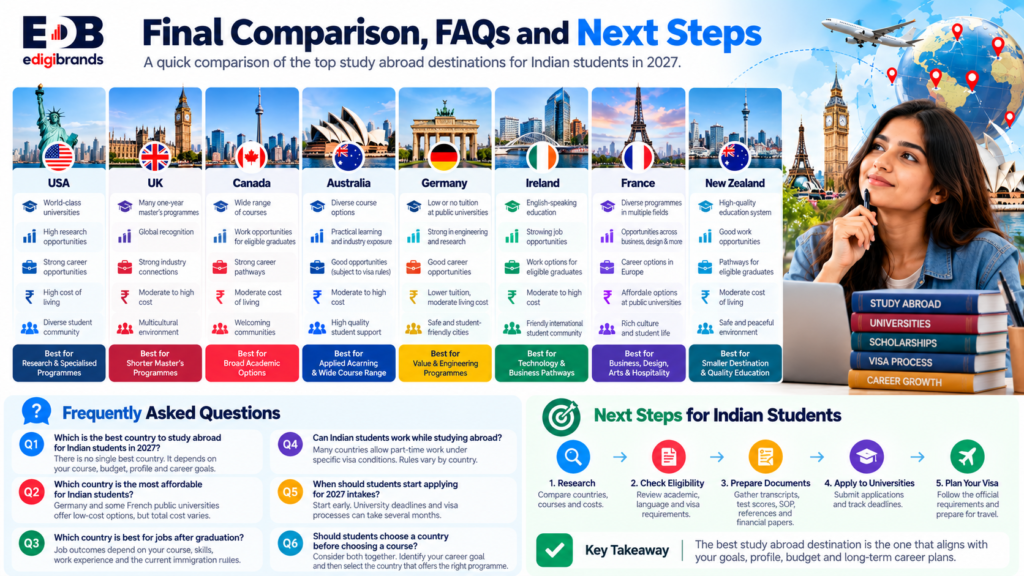
3. Final Comparison, FAQs and Next Steps
Quick Comparison of the Best Countries to Study Abroad in 2027
| Country | Main strengths | Key considerations | May suit students who… |
|---|---|---|---|
| United States | Research, specialisation, wide programme choice | Potentially high costs; check visa and training rules | Want specialised or research-intensive education |
| United Kingdom | Many one-year master’s programmes, English-speaking environment | Tuition, living costs, and 2027 Graduate visa changes | Want a shorter postgraduate study timeline |
| Canada | Broad academic options and multicultural cities | Check current study permit and programme eligibility | Want to compare technical, research, and professional courses |
| Australia | Wide course selection and applied learning | Living costs and visa conditions | Want practical or professional programmes |
| Germany | Many public-university options with low or no general tuition | Qualification recognition, language, and financial requirements | Prioritise engineering, science, technology, or value |
| Ireland | English-speaking education and selected technology or business pathways | Accommodation costs and permission eligibility | Want to study in an English-speaking European destination |
| France | Diverse institutions and selected affordable public options | Fee category and French-language requirements | Are interested in business, design, engineering, arts, or hospitality |
| New Zealand | English-speaking study environment and selected applied programmes | Smaller course market; check costs and current visa rules | Prefer a smaller destination and a suitable specific programme |
This table is a starting point, not a universal ranking. Actual suitability depends on the course, university, student’s finances, admission profile, and current immigration rules.
Frequently Asked Questions
Which is the best country to study abroad for Indian students in 2027?
There is no single best country for every student. The United States may suit students prioritising research and specialised programmes; Germany may appeal to those seeking eligible public-university options; and the UK may suit students considering one-year master’s programmes. Ireland, Canada, Australia, France, and New Zealand also offer options worth evaluating. The right choice depends on the individual profile and current rules.
Which country is the most affordable for Indian students?
Affordability depends on tuition fees, living costs, scholarships, city, and course duration. Germany and selected French public-university options may be worth investigating, but students should verify the actual fees and financial requirements for their exact programme. Low tuition does not automatically mean low overall cost.
Which country is best for jobs after graduation?
Job opportunities depend on the student’s field, qualifications, language skills, work experience, local labour market, and immigration eligibility. No country can guarantee employment simply because a student completes a degree there. Research programme-level outcomes and the current work rules before choosing.
Can Indian students work while studying abroad?
Many destinations allow eligible international students to work under specified conditions. The permitted hours, type of work, and eligibility vary by country and visa. Students should confirm the rules with the relevant government authority and should not depend on part-time work as their only source of funding.
When should students start applying for 2027 intakes?
Start researching as early as possible. Some universities and scholarships have deadlines many months before the course begins, and visa preparation also takes time. Check each university’s official calendar because application timelines vary by country, course, and intake.
Should students choose a country before choosing a course?
Ideally, students should consider the course and destination together. Begin with the subject, career objective, academic eligibility, and budget. Then shortlist countries and universities that provide a suitable programme and realistic overall cost.
Conclusion: Choose the Country That Fits Your Goals
The best countries to study abroad for Indian students in 2027 are not simply the most popular destinations. They are the countries where a student’s academic profile, chosen programme, finances, language skills, and long-term goals align.
Before deciding, compare at least three destinations, shortlist suitable universities, calculate the full cost of study, and verify current visa and post-study rules through official sources. A careful decision can help students avoid unnecessary expenses and focus on programmes that genuinely support their ambitions.
For education businesses, helping students make informed choices also builds credibility. Edigibrands supports education-focused businesses with digital marketing and lead-generation strategies designed to attract relevant enquiries and improve the student journey. Explore our study abroad marketing strategy or learn more about our EdTech and education marketing services.