
Study abroad consultants often focus heavily on generating leads.
More leads are usually seen as the solution to increasing admissions.
But lead volume alone does not create predictable enrollment.
A consultancy can generate hundreds of enquiries and still struggle to convert them into applications and admissions if the process after lead generation is inconsistent.
Some leads may receive a call immediately. Others may be contacted hours later. Some may receive WhatsApp follow-ups, while others may receive nothing after the first conversation. Counsellors may use different approaches, and management may not have a clear view of where each student stands.
This creates an unpredictable admission process.
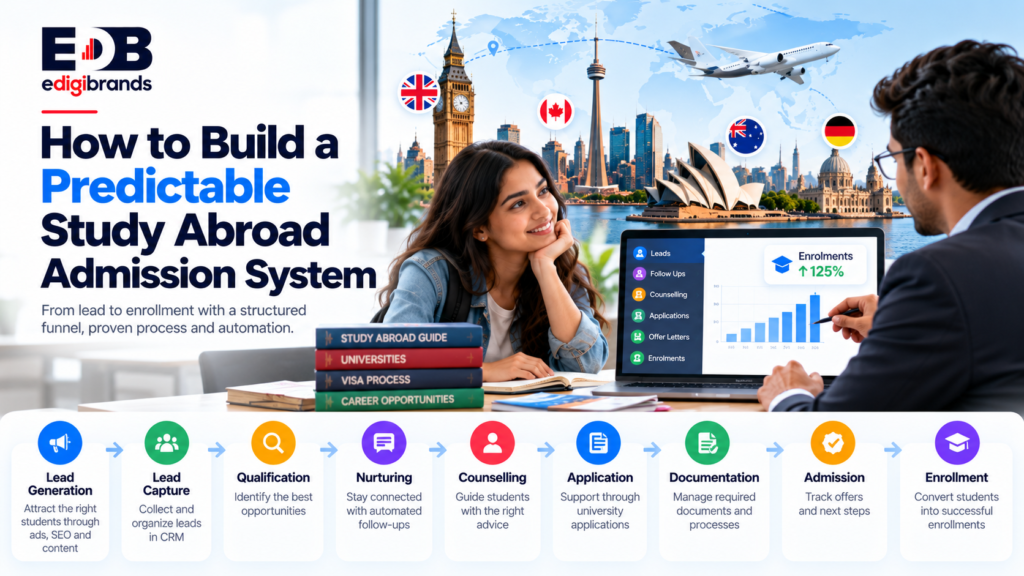
A better approach is to build a study abroad admission system where every stage is connected:
Lead Generation → Lead Capture → Qualification → Nurturing → Counselling → Application → Documentation → Admission → Enrollment
The objective is not simply to generate more leads.
The objective is to create a repeatable lead-to-enrollment system that gives the team a clear process for moving students from their first interaction to enrollment.
What Is a Predictable Study Abroad Admission System?
A predictable admission system is a structured process that connects marketing, sales, counselling and operations.
Instead of treating every lead as an individual case, the consultancy creates defined stages, actions and follow-up processes.
A simplified system looks like this:
Traffic → Lead → Qualification → Follow-Up → Counselling → Application → Offer → Visa/Documentation → Enrollment
Every stage should have:
- A clear objective
- Defined responsibilities
- Required information
- Follow-up actions
- Tracking
- Automation where appropriate
- A measurable conversion rate
This creates visibility across the entire student journey.
Why Lead Generation Alone Is Not Enough
Generating a lead is only the beginning.
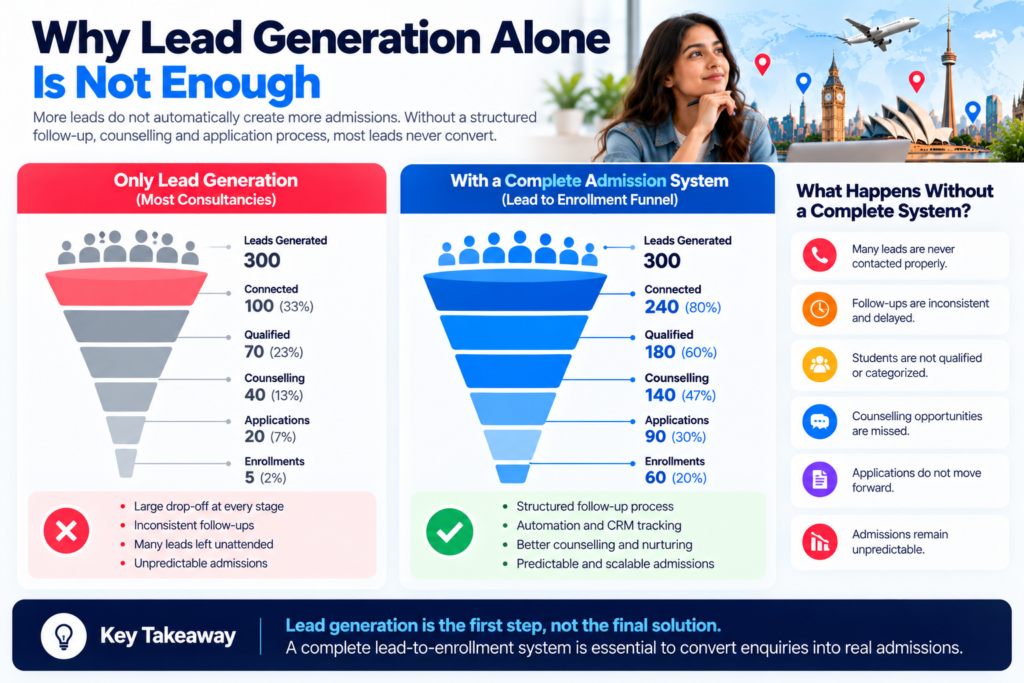
Consider a consultancy that generates 300 leads in a month.
If:
- 100 leads are never contacted properly
- 70 do not respond after the first attempt
- 50 are not qualified
- 40 are interested but not followed up consistently
- 20 receive counselling
- 10 start applications
- 5 eventually enroll
The problem may not be lead generation.
The bigger problem could be the conversion system between the lead and the admission.
This is why the focus should shift from:
“How many leads did we generate?”
to:
“What happened to every lead after it entered our system?”
A strong acquisition strategy should also focus on generating high-quality study abroad leads consistently, because better lead quality makes the downstream conversion system more effective.
Map the Complete Student Journey
Before implementing automation or CRM workflows, map the actual student journey.
For example:
Stage 1 — Lead Generated
Student submits an enquiry through an advertisement, website, webinar or other channel.
Stage 2 — Lead Captured
The lead enters the CRM with the relevant information.
Stage 3 — First Contact
The team attempts to connect with the student.
Stage 4 — Qualification
The consultancy understands the student’s academic profile, destination, course, intake, budget and requirements.
Stage 5 — Nurturing
Students who are not immediately ready continue receiving relevant communication.
Stage 6 — Counselling
A qualified student has a detailed discussion with the counsellor.
Stage 7 — Application
The student begins the university/application process.
Stage 8 — Documentation
Required documents and application requirements are managed.
Stage 9 — Offer / Next Steps
The student progresses toward admission and subsequent processes.
Stage 10 — Enrollment
The student completes the required steps and becomes an enrolled student.
The exact stages can vary between consultancies, but the important principle is the same:
Every lead needs a defined journey.
How to Build the Lead-to-Enrollment Conversion Funnel
Create Clear Lead Qualification Criteria
Not every lead should be treated equally.
A qualification framework helps the team understand whether a student is:
- Exploring
- Researching
- Interested
- Ready for counselling
- Ready to apply
- Already applying elsewhere
- Not currently qualified
Qualification can be based on factors such as:
Academic profile → Destination → Course → Intake → Budget → Work experience → Documentation → Intent
The objective is not to reject students too quickly.
It is to understand where they are in the decision-making process.
A student who is not ready today may still become a strong opportunity several months later.
Define Lead Stages in the CRM
A predictable system needs clearly defined CRM stages.
For example:
New Lead
↓
Contact Attempted
↓
Connected
↓
Qualified
↓
Counselling Scheduled
↓
Counselling Completed
↓
Application Started
↓
Application Submitted
↓
Offer Received
↓
Admission / Enrollment
These stages make it easier for management to understand the pipeline.
Instead of asking:
“How many leads do we have?”
the team can ask:
“How many qualified students are currently at the counselling stage?”
or:
“How many applications are waiting for documentation?”
That creates much better operational visibility.
Build a Follow-Up System Instead of Relying on Memory
One of the biggest problems in lead conversion is inconsistent follow-up.
A counsellor may speak to a student today and plan to call again after three days.
But when the day arrives, another lead may take priority.
The follow-up gets delayed.
Then the student becomes inactive.
A proper system should define:
Who should be contacted → When they should be contacted → Through which channel → With what message → What happens next
For example:
Day 0: First call
Day 0: WhatsApp confirmation/resource
Day 1: Follow-up
Day 3: Relevant information
Day 5: Objection or concern-based follow-up
Day 7: Counselling invitation
Day 14: Nurturing message
The exact sequence should depend on the student’s stage and behaviour.
This is where a structured lead nurturing strategy for study abroad consultants becomes important.
Separate Immediate Leads From Future-Intake Leads
One of the most important parts of a study abroad admission system is recognising that students operate on different timelines.
For example:
Student A: Wants to apply immediately.
Student B: Planning for the next intake.
Student C: Still researching countries.
Student D: Needs to arrange finances.
Student E: Has not completed required exams.
Treating all five students as “new leads” is not useful.
Instead, assign each student to the appropriate stage and timeline.
This allows the consultancy to build different nurturing systems.
A future-intake student should not be forgotten simply because they are not ready today.
Connect Marketing With Counselling
The marketing team and counselling team should not operate as separate departments.
Marketing generates the opportunity.
Counselling converts the opportunity.
The information collected during lead generation should therefore help the counselling team.
For example, if a student comes through an advertisement for:
“Study in Canada for September Intake”
the counsellor should ideally know that context before making the first conversation.
This creates a more relevant experience.
It also reduces the need for the student to repeatedly explain why they contacted the consultancy.
Use Automation Where It Actually Helps
Automation should support the team, not replace the human counselling process.
Useful automation can include:
- Instant lead acknowledgement
- CRM lead creation
- Lead assignment
- WhatsApp confirmations
- Email sequences
- Counselling reminders
- Appointment reminders
- Follow-up tasks
- Future-intake nurturing
- Webinar reminders
- Retargeting audiences
- Internal notifications
For example:
New Lead
→ CRM entry
→ Automatic acknowledgement
→ Counsellor assignment
→ First-call task
→ Follow-up sequence
→ Qualification
→ Counselling
→ Application workflow
The objective is to reduce the number of opportunities lost because someone forgot to perform a routine task.
How to Make the Admission System Predictable and Scalable
Track Conversion Between Every Stage
Predictability comes from measurement.
Instead of tracking only total leads and total admissions, measure the conversion rate between stages.
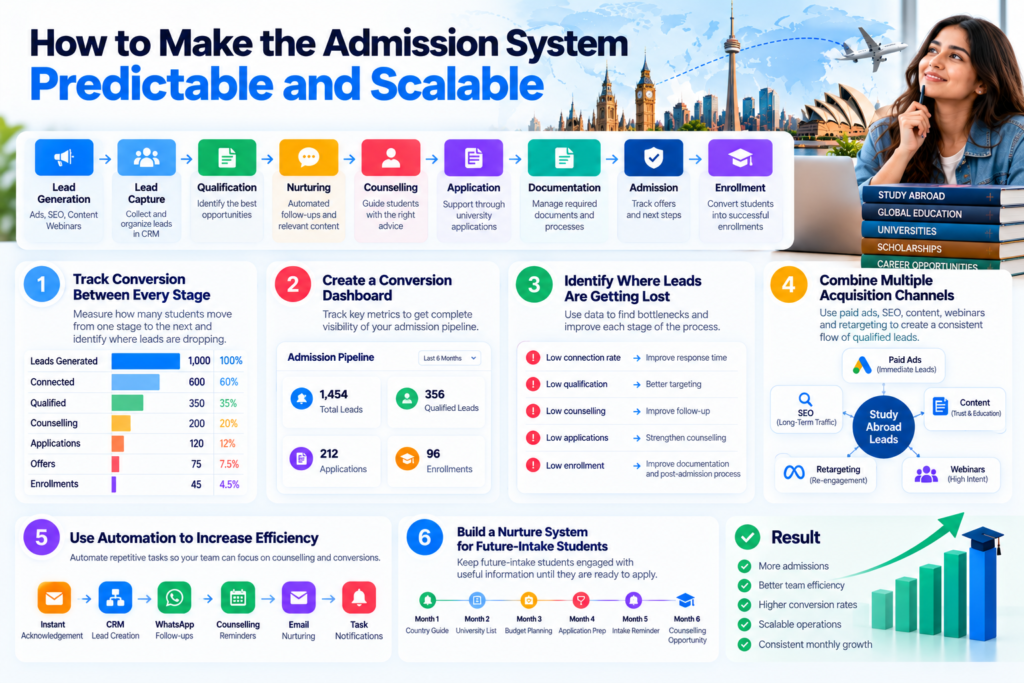
For example:
1,000 Leads
↓
600 Connected
↓
350 Qualified
↓
200 Counselling Sessions
↓
120 Applications
↓
75 Offers
↓
45 Enrollments
This gives management a much clearer picture of the business.
If 1,000 leads produce only 50 connected conversations, the problem may be contactability.
If 350 qualified leads produce only 20 counselling sessions, the problem may be follow-up or scheduling.
If 200 counselling sessions produce only 10 applications, the issue may be counselling, trust, pricing, profile fit or another conversion barrier.
The numbers help identify where the system is breaking.
Create a Conversion Dashboard
A useful dashboard should show more than lead volume.
Track:
| Stage | Metric |
|---|---|
| Lead Generation | Leads generated |
| Contact | Connected leads |
| Qualification | Qualified leads |
| Counselling | Counselling sessions |
| Application | Applications started |
| Submission | Applications submitted |
| Offer | Offers received |
| Enrollment | Enrollments |
| Revenue | Revenue generated |
You can also measure performance by:
- Marketing source
- Country
- Course
- Intake
- Counsellor
- Campaign
- Lead quality
- Conversion rate
This helps identify where the strongest opportunities are coming from.
Identify Where Leads Are Getting Lost
A predictable system should make leakage visible.
For example:
Large number of leads + low connection rate
Possible issue:
- Slow response
- Incorrect contact information
- Poor lead quality
- Inconsistent calling
Strong connection rate + low qualification
Possible issue:
- Poor targeting
- Wrong audience
- Weak qualification criteria
Strong qualification + low counselling
Possible issue:
- Weak follow-up
- Poor appointment process
- Lack of trust
Strong counselling + low applications
Possible issue:
- Counselling approach
- Pricing
- Profile mismatch
- Student objections
- Lack of urgency
Strong applications + low enrollment
Possible issue:
- Documentation
- Visa process
- Offer management
- Student drop-off
- Poor post-admission follow-up
This is why a complete funnel is more valuable than simply increasing advertising spend.
Combine Paid Ads, SEO and Retargeting
A predictable admission system should not depend on a single lead source.
A stronger acquisition model can combine:
Paid Ads
→ Immediate lead generation
SEO
→ Long-term organic traffic
Content
→ Trust and education
Webinars
→ Engagement and intent
Retargeting
→ Re-engagement
CRM + WhatsApp
→ Nurturing
Counselling
→ Conversion
This creates a connected acquisition ecosystem.
For example, a student may first discover a consultancy through SEO content, later see a retargeting advertisement, attend a webinar and eventually book counselling.
The first touchpoint does not always create the final conversion.
Build a Student Objection Management System
Students often delay applications because of uncertainty.
Common concerns can include:
- Cost
- Country selection
- University selection
- Career outcomes
- Eligibility
- Visa concerns
- Family approval
- Documentation
- Timing
- Comparison with other consultancies
These objections should not be treated as random problems.
Build an objection library.
For every common objection, define:
Objection → Response → Proof → Resource → Next Step
For example:
Objection: “Studying abroad is too expensive.”
Response: Explain the total cost structure.
Proof: Provide realistic examples and available funding options.
Resource: Share a relevant cost guide.
Next Step: Offer a profile-based discussion.
This gives counsellors a more consistent approach.
Create a Nurture System for Students Who Are Not Ready
One of the biggest mistakes is treating a student as lost simply because they are not ready to apply today.
A student may need:
- More time
- Better finances
- Improved academic preparation
- IELTS/PTE preparation
- Family approval
- University research
- A future intake
Instead of repeatedly asking:
“Are you ready to apply?”
the consultancy can continue providing useful information.
For example:
Month 1: Country guide
Month 2: University shortlist
Month 3: Budget planning
Month 4: Application preparation
Month 5: Intake reminder
Month 6: Counselling opportunity
This turns the CRM into a long-term student relationship system.
Review the Funnel Every Month
A predictable system is not a system that never changes.
Review it regularly.
Ask:
- Which campaigns generate the best qualified leads?
- Which countries convert better?
- Which counsellors have stronger conversion rates?
- Where are leads dropping?
- Which follow-ups generate responses?
- Which objections appear most often?
- Which content generates enquiries?
- Which stages require more automation?
- Which campaigns generate admissions rather than just leads?
This creates a continuous improvement loop:
Measure → Identify → Improve → Test → Measure Again
Final Thoughts
A predictable study abroad admission system is not built by simply increasing lead volume.
It is built by connecting the entire journey:
Lead Generation → Qualification → Follow-Up → Counselling → Application → Admission → Enrollment
The most important shift is to stop thinking of leads as isolated enquiries.
Every lead should enter a system.
Every stage should have a defined process.
Every important action should be tracked.
And every student who is not ready today should have a reason to remain connected with the consultancy.
When paid advertising, SEO, content, retargeting, CRM, WhatsApp, automation and counselling work together, the consultancy can move from a lead-generation model toward a more predictable lead-to-enrollment system.
The goal is not simply:
More Leads.
It is:
More Qualified Leads → Better Follow-Up → More Counselling → More Applications → More Enrollments.
For a broader understanding of lead generation, explore How to Generate High-Quality Study Abroad Leads Consistently.
To understand why some campaigns generate leads but fail to produce enrollments, read Why Most Study Abroad Ads Fail and What Actually Drives Enrollments.
For the re-engagement stage, see Retargeting Strategy for Study Abroad Leads.
You can also explore The Ultimate Lead Nurturing Strategy for Study Abroad Consultants for the nurturing layer of the system.
For Edigibrands’ broader lead-generation solutions, visit Edigibrands or Contact Us.