

Introduction
Getting a study abroad lead is only the beginning of the student acquisition journey.
The real challenge starts when the student begins asking questions.
“Is this university good?”
“Why should I choose this country?”
“The fees are too high.”
“I need to discuss this with my parents.”
“I am still comparing other consultants.”
“Can you guarantee my visa?”
“I will get back to you.”
These statements are often treated as rejection, but that is not always what they mean.
In many cases, an objection is simply a sign that the student has not yet received enough information, confidence, clarity, or trust to make a decision.
This is particularly important in study abroad consulting because students are not making a small purchase. They are making a decision involving education, finances, career plans, family expectations, immigration considerations, and sometimes several years of their life.
That means a consultant cannot approach the conversation like a traditional sales call.
The objective should not be to pressure the student into saying yes.
The objective is to understand the concern, identify what is actually stopping the decision, provide relevant information, and help the student move to the next logical step.
This is where structured student objection handling becomes an important part of the admissions process.
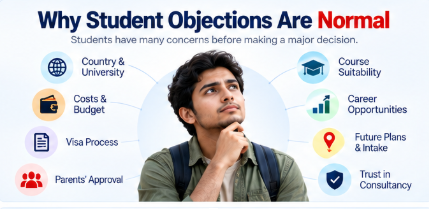
Why Student Objections Are Normal
A student who says, “I need to think about it” may not necessarily be uninterested.
They could be uncertain about:
- The country
- University selection
- Course suitability
- Tuition fees
- Living expenses
- Scholarship availability
- Visa requirements
- Their academic profile
- Their English-language test score
- Parents’ approval
- Career opportunities
- The credibility of the consultancy
- Whether they should start now or later
The mistake is to respond to the sentence instead of understanding the reason behind it.
For example:
Student: “Your fees are expensive.”
A weak response would be:
“Our fees are actually very reasonable.”
A better response would begin with:
“I understand. When you say the fees are high, are you mainly comparing us with another consultancy, or are you concerned about the overall cost of studying abroad?”
The second approach opens the conversation.
The first one starts an argument.
The Difference Between an Objection and a Real Barrier
Not every objection has the same importance.
Some objections are surface-level concerns, while others are genuine barriers to moving forward.
Consider a student saying:
“I need to discuss this with my parents.”
That could mean several things.
Perhaps the parents genuinely need to approve the decision.
Perhaps the student has not understood the value of the service.
Perhaps the student is interested but wants more information before discussing it with the family.
Or perhaps the student simply wants to end the conversation politely.
The consultant’s job is not to assume which one it is.
The consultant needs to diagnose it.
A useful question would be:
“Absolutely. What information would help you explain the decision to your parents?”
Now the conversation becomes more specific.
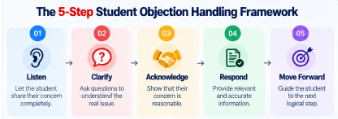
The Five-Step Student Objection Handling Framework
A simple framework can help counsellors handle objections without becoming overly aggressive.
1. Listen
Allow the student to complete the thought before responding.
Do not interrupt with a prepared answer.
The student may reveal the real concern if you give them enough space.
2. Clarify
Ask a short question to understand the actual issue.
For example:
“Is the concern mainly about the cost, or are you still comparing universities?”
This helps separate the real objection from the surface statement.
3. Acknowledge
Show the student that their concern is reasonable.
This does not mean agreeing with everything they say.
It simply means demonstrating that you have understood the concern.
For example:
“That makes sense. Choosing a university is a major financial decision, so comparing the total cost is important.”
4. Respond With Relevant Information
Once you know the actual concern, provide information specifically related to it.
Do not overload the student with ten unrelated benefits.
If the concern is cost, discuss cost.
If the concern is university selection, discuss university selection.
If the concern is visa uncertainty, explain the process and relevant requirements without making promises that cannot be guaranteed.
5. Move to the Next Step
The objective of objection handling is not to keep talking indefinitely.
Once the concern has been addressed, move the student toward a specific next action.
For example:
“Based on your profile, the next useful step would be to shortlist the universities that fit your academic background and budget. Shall we do that together?”
This is much more natural than:
“So, are you ready to buy?”
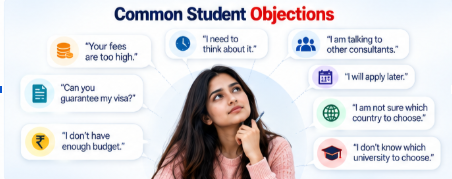
The Most Common Student Objections
Different consultancies will encounter different objections, but several appear repeatedly during study abroad counselling.
Let’s look at how to approach them.
1. “Your Fees Are Too High”
Price is one of the most common objections in any consulting business.
But the first mistake is assuming that a price objection is always about price.
Sometimes the student simply does not understand what they are paying for.
Before defending your fee, understand what the student is comparing.
Ask:
“Are you comparing our fees with another consultancy, or are you trying to stay within a particular overall study abroad budget?”
This gives you context.
If they are comparing consultancy fees, you can explain what your service includes.
If the issue is the overall study abroad budget, the conversation needs to shift toward university, country, tuition and living-cost considerations.
The consultant should avoid immediately offering a discount because that can turn the conversation into a price negotiation before the actual value has been understood.
2. “I Need to Think About It”
This is one of the most common statements in sales conversations.
The problem is that “I need to think about it” tells you almost nothing.
Instead of pushing for an immediate decision, identify what the student needs to think about.
Try:
“Of course. Before you decide, is there any particular part you are still unsure about?”
If they say:
“I am not sure about the country.”
You now have a specific issue.
If they say:
“I need to discuss the budget with my parents.”
Again, you have a specific issue.
If they say:
“I am comparing universities.”
You can help with the comparison.
The key is to turn a vague objection into a specific question.
3. “I Am Talking to Other Consultants”
This should not automatically be treated as a threat.
Students are often going to compare consultants before making a decision.
Instead of attacking competitors, ask what the student is comparing.
For example:
“That’s completely understandable. What are the main things you’re comparing between the consultants?”
The student may mention:
- Fees
- University options
- Application support
- Visa support
- Reviews
- Experience
- Response time
- Scholarships
- Country expertise
Now you know what matters to them.
This is where your positioning becomes important.
Your strong study abroad brand should make your expertise, process, credibility and differentiation clear before the sales conversation even happens.
The objective is not to convince the student that every competitor is bad.
It is to make sure the student understands what your consultancy actually does differently.
4. “Can You Guarantee My Visa?”
This is a particularly sensitive objection because students may want certainty in an area where certainty cannot responsibly be promised.
The response should be factual and transparent.
Instead of making an absolute promise, explain what your consultancy can actually control.
For example:
“We cannot control the final visa decision, but we can help you understand the requirements, prepare the documentation correctly and identify potential issues in your application.”
This builds more credibility than making a promise that is outside your control.
Trust is especially important because students and parents are often evaluating whether they can rely on the consultancy throughout a high-stakes process.
5. “I Don’t Have Enough Budget”
This objection needs to be explored rather than immediately countered.
Ask:
“Is the concern your consultancy budget, or the total budget required for studying abroad?”
These are two completely different problems.
If the student is concerned about the overall cost, explore:
- Country options
- University options
- Tuition fees
- Living costs
- Scholarships
- Intake
- Funding options
If the student has a fixed financial constraint, the consultant should help determine whether the student’s preferred plan is realistic.
Sometimes the right answer is not to push the student toward a decision.
It is to help them understand what options actually fit their situation.
6. “I Will Apply Later”
This objection can often be connected to timing.
A student may genuinely be targeting a future intake.
Instead of treating them as a lost lead, identify their timeline.
Ask:
“Which intake are you planning for?”
Then:
“What are you planning to complete before that intake?”
This creates an opportunity to build a timeline.
For example:
Profile evaluation → Course shortlist → University shortlist → Application → Offer → Documentation → Visa
A student who is not ready today may still become a valuable future applicant if the consultancy continues to educate and nurture them.
This is why consistent communication matters. You can read more about this in why consistency matters more than budget in study abroad lead generation.
7. “I Am Not Sure Which Country to Choose”
This is not necessarily an objection.
It may actually be an opportunity for counselling.
Do not immediately tell the student:
“You should choose the UK.”
Instead, understand the decision criteria.
Ask questions around:
- Preferred course
- Academic background
- Budget
- Career goals
- Intake
- Work preferences
- Location preferences
- Family considerations
- Long-term objectives
Then compare relevant options.
The consultant becomes more valuable when they help the student make sense of the decision rather than simply pushing a predetermined destination.
8. “I Don’t Know Which University to Choose”
This is another situation where education is more effective than pressure.
Instead of giving the student a huge list of universities, create a selection framework.
For example:
Profile → Course → University → Location → Cost → Career considerations
Explain why certain universities may fit the student’s profile better than others.
This also gives you an opportunity to demonstrate expertise.
The student should finish the conversation with greater clarity than they had before the conversation began.
Objection Handling Should Begin Before the Sales Call
One of the biggest mistakes is waiting until the counselling call to answer every possible question.
Your marketing should already address common concerns.
Your website, landing pages, social content, email campaigns and WhatsApp communication can answer questions before the student speaks with your counsellor.
For example, if students frequently ask about cost, create content around study abroad expenses.
If students frequently ask about university selection, create university comparison content.
If students worry about the application process, explain the process clearly.
This is one reason a strong study abroad lead generation system should include both lead generation and lead education.
Use Content to Pre-Handle Objections
Think of your content as an extension of your counselling team.
A student might ask:
“How much money do I need to study in the UK?”
Create an article answering it.
Another might ask:
“How do I choose between two universities?”
Create a comparison guide.
Another might ask:
“What happens after I submit my application?”
Create a step-by-step guide.
Over time, these resources can reduce repetitive conversations while also building credibility.
This connects directly with content marketing for study abroad leads.
The Role of Email and WhatsApp in Objection Handling
Not every objection should be handled during one phone call.
Some students need time.
This is where nurturing becomes important.
Suppose a student says:
“I am interested, but I am planning for the next intake.”
Instead of closing the lead as lost, you can create a follow-up sequence.
For example:
Day 1: Helpful country guide
Day 4: University comparison
Day 7: Cost information
Day 14: Student success story
Day 21: Counselling invitation
The purpose is not to repeatedly ask:
“Have you decided?”
The purpose is to provide useful information that helps the student move forward.
A structured email marketing strategy for study abroad leads can therefore become part of the conversion process rather than simply being a promotional channel.
Build a Student Objection Library
If your counsellors repeatedly receive the same questions, document them.
Create a simple internal database containing:
| Objection | What It May Mean | Suggested Question | Relevant Resource |
| Fees are high | Price/value concern | What are you comparing? | Fee/service breakdown |
| Need to think | Unclear concern | What are you unsure about? | FAQ |
| Need parents’ approval | Family decision | What information do they need? | Parent guide |
| Comparing consultants | Evaluation stage | What are you comparing? | Service comparison |
| Not ready yet | Future intake | Which intake? | Intake guide |
| Don’t know country | Decision uncertainty | What matters most to you? | Country comparison |
| Visa concern | Risk perception | What part concerns you? | Visa process guide |
This creates consistency across your counselling team.
It also prevents every counsellor from inventing a completely different response.
Do Not Turn Objection Handling Into Manipulation
There is an important difference between helping someone make a decision and trying to overcome every objection at any cost.
If a student is genuinely not eligible, cannot afford the proposed option, or is simply not ready, forcing the conversion may create problems later.
A successful admission process should consider fit.
The objective is not:
Convert every lead.
The objective is:
Identify the right students, educate them properly, and help qualified students move forward with confidence.
This approach can also improve lead quality because your marketing and counselling process becomes more focused on the right audience.
Improve the Conversion Process Around the Objections
If the same objections appear repeatedly, do not assume the counsellors are the only problem.
The objection may be coming from your marketing system.
For example:
Students repeatedly ask about pricing.
Your offer may not be clear enough.
Students repeatedly question your credibility.
Your website may lack sufficient trust signals.
Students repeatedly ask what happens after submitting a lead.
Your process may not be explained clearly.
Students repeatedly ask which country is suitable.
Your campaigns may be attracting students before they understand their own requirements.
Students repeatedly disappear after the first call.
Your follow-up system may need improvement.
This is why lead generation and conversion should be analysed together.
If your consultancy is generating enquiries but struggling to convert them, review why your study abroad leads are not converting and what you’re missing.
Measure Objections Like Data
Objections should not exist only as conversations inside a counsellor’s head.
Track them.
For every significant lead, record the primary reason they did not move forward.
After 100 or 200 leads, patterns begin to appear.
You may discover that:
- A large number are price-sensitive.
- Many are waiting for another intake.
- A significant percentage need parental approval.
- Certain campaigns produce poor-fit students.
- One country attracts more qualified leads.
- One offer generates many enquiries but few applications.
Now you have information that can improve your marketing.
This creates a feedback loop:
Ads → Leads → Objections → Counselling → Conversion Data → Marketing Optimisation
That is far more useful than simply looking at the number of leads generated.
A Simple Closing Framework
Once the student’s major concern has been addressed, the closing process should feel like the natural next step.
A simple framework is:
Confirm
“So your main concern was finding universities within your budget, correct?”
Resolve
Provide the relevant information.
Summarise
“Based on your profile, we’ve identified options that fit your course preference and budget range.”
Next Step
“The next step would be to complete your profile evaluation and shortlist the universities.”
This is a consultative close.
The student understands what happens next and why.
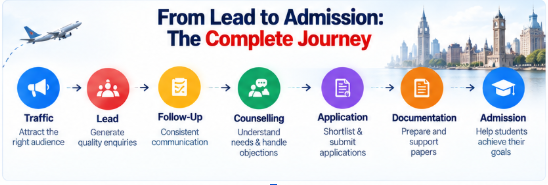
From Lead Generation to Admission
A consultancy cannot build a predictable admissions pipeline by focusing only on acquiring more enquiries.
The full process looks more like:
Traffic → Lead → Qualification → Follow-Up → Counselling → Objection Handling → Application → Documentation → Admission
Every stage affects the next one.
If the traffic is poor, lead quality suffers.
If the lead qualification is weak, counsellors waste time.
If follow-up is inconsistent, interested students disappear.
If counselling is unclear, objections increase.
If application support is weak, students may drop before completion.
This is why the lead sources of study abroad consultants should be evaluated alongside the entire conversion journey.
Final Thoughts
Student objections are not necessarily the enemy of your admissions process.
In many cases, they are signals.
They tell you what the student still does not understand, what they are worried about, what they are comparing, or what information they need before making a decision.
The strongest counselling teams do not try to eliminate objections.
They learn from them.
They listen carefully, ask better questions, understand the actual concern, provide relevant information and guide the student toward an appropriate next step.
More importantly, the same objections should eventually influence your marketing.
If students repeatedly ask the same question, create content around it.
If they repeatedly question your value, improve your positioning.
If they repeatedly disappear after submitting an enquiry, improve your follow-up.
If they repeatedly compare you with competitors, strengthen your differentiation and trust signals.
And if you are generating plenty of leads but still seeing weak conversions, do not immediately assume that you need more leads. First examine where the existing leads are getting stuck.
Better objection handling is not about becoming better at convincing students.
It is about becoming better at understanding students.
And when your marketing, follow-up, counselling and conversion process are built around that understanding, the path from enquiry to application becomes much clearer.
For consultancies looking to improve the complete acquisition process, you can also explore why most study abroad ads fail and what actually drives enrollments.
If you want to discuss how your current lead generation and conversion system can be improved, you can book a strategy call with Edigibrands or contact the team.