
 Introduction
Many Indian students want to study overseas but worry that taking IELTS may add time, cost, or pressure to their application. Some universities and programmes accept other ways to demonstrate English proficiency, such as previous education in English, a Medium of Instruction (MOI) letter, another recognised English test, or an institution-specific assessment.
However, “study abroad without IELTS” does not mean every university waives English-language requirements. Rules vary by country, university, course, degree level, intake, and visa route. Always verify current requirements on official course and admissions pages before applying.
1. What Does “Study Abroad Without IELTS” Actually Mean?
IELTS is one way to prove English proficiency, but it is not the only method used by every institution. A university may not require IELTS specifically while still asking applicants to demonstrate English ability through another accepted route.
- IELTS waiver: The institution agrees that an applicant does not need to submit IELTS, often because the applicant meets a defined exemption policy.
- Alternative English test: The institution accepts another test, such as TOEFL iBT or PTE Academic, subject to its current policy.
- Medium of Instruction (MOI): The institution considers evidence that a previous qualification was taught and assessed in English.
- Previous education or qualifications: Certain school, college, or university qualifications may meet the institution’s English-language criteria.
- University assessment or pathway: Some institutions may offer an internal assessment, interview, or pre-sessional English programme.
These options are not interchangeable. An MOI letter accepted by one university may be rejected by another, and an admission waiver does not automatically settle every immigration or visa requirement.
 2. Countries Where Students Can Explore Study Abroad Without IELTS
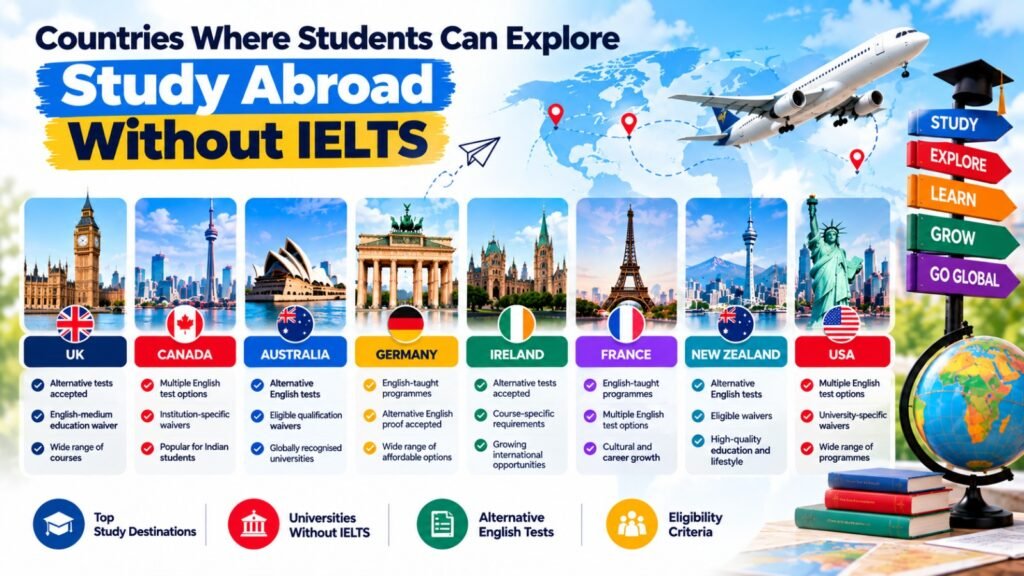
Students can investigate options in several popular destinations. Treat these as places to research, not as countries with blanket IELTS exemptions.
United Kingdom (UK)
Some UK universities may accept alternative English qualifications, previous education in English, or an MOI letter in defined circumstances. Requirements can vary by course and visa route. Check the course page and the university’s official English-language policy.
Canada
Some Canadian institutions may consider prior English-medium education or accept tests other than IELTS. Policies differ between universities, colleges, programmes, and levels of study. Confirm whether the exemption applies to your exact programme and whether separate study-permit documentation is needed.
Australia
Australian institutions set their own English-language entry requirements and may recognise a range of tests or specified previous qualifications. Some programmes have stricter requirements, especially in regulated fields. Check the current university policy and applicable visa requirements.
Germany
English-taught programmes in Germany may ask for recognised test scores or other evidence of English proficiency. Some programmes may consider previous English-medium education, while others may insist on a specific test. Requirements are programme-specific.
Ireland
Irish universities and colleges publish their own English-language requirements. Some may accept alternative tests or specified previous qualifications, but accepted evidence and minimum scores differ by institution and course.
France
For English-taught courses in France, check whether the programme requires a test score, accepts an alternative qualification, or permits evidence of previous education in English. Do not assume a waiver is available simply because the course is taught in English.
United States (USA)
US universities may accept tests such as TOEFL or other institution-approved evidence, and some may offer waivers based on previous study or other criteria. Policies vary between institutions and departments.
New Zealand
New Zealand institutions may accept specified alternative English tests or other evidence under their own admissions rules. Check the institution’s course requirements and relevant immigration guidance.
Important: The countries above are starting points for research, not a guarantee that IELTS is unnecessary. Confirm the current rules directly with the university and relevant immigration authority.
 3. Universities Without IELTS: How to Find Suitable Options
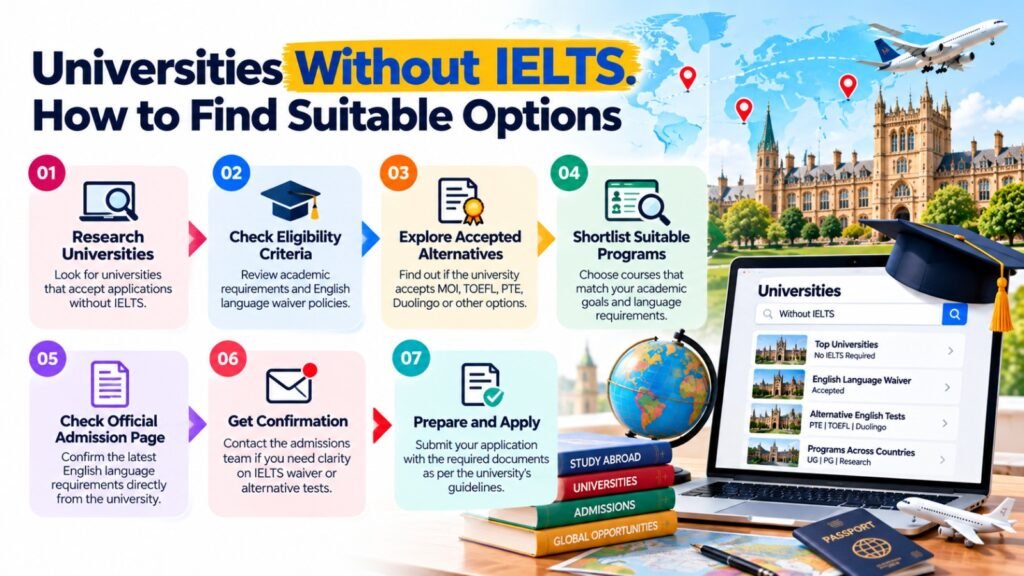
Instead of relying on generic lists that may be outdated, use a repeatable verification process to shortlist universities.
- Start with the exact course, intake, and degree level on the university’s official website.
- Open the official English-language requirements page and review accepted tests, exemptions, previous-study rules, and minimum scores.
- Search for terms such as “English language waiver,” “Medium of Instruction,” “English-medium education,” or “alternative English qualifications.”
- Check whether the policy applies to Indian qualifications and your specific school board or university.
- Confirm any limits on the age of your previous qualification, minimum grades, and duration of English-medium study.
- Email admissions if the wording is unclear. Ask for written confirmation before paying application fees or making travel plans.
- Save a copy of the policy and the response you receive, including the date.
4. Can an MOI Certificate Replace IELTS?
A Medium of Instruction (MOI) certificate or letter is issued by a school, college, or university to confirm the language used for teaching and assessment. Some institutions may accept it as evidence of English proficiency, but acceptance depends on their policy.
An MOI letter may need to include:
- The student’s full name and qualification details.
- The institution’s official name and contact details.
- Confirmation that the programme was taught and assessed in English.
- The dates or duration of study.
- An authorised signature, stamp, or official verification.
Do not assume that a letter stating “the course was in English” is sufficient. Some universities restrict MOI waivers by qualification level, country, course, time since graduation, or visa category. Ask admissions whether the exact document will be accepted.
5. Alternative English Tests to Consider
If IELTS is not suitable, check whether your chosen institution accepts another recognised English-language test. Acceptance and minimum scores vary.
- TOEFL iBT: Accepted by many institutions, subject to their current score and test-format rules.
- PTE Academic: An option at institutions that list it among their approved English tests.
- Duolingo English Test: Accepted by some institutions and programmes, but not universally accepted.
- Cambridge English qualifications: May be accepted by institutions that list the relevant qualification and grade.
- Institution-specific assessment or pathway course: Some universities offer an assessment or English preparation route for eligible students.
Before booking a test, confirm the required version, minimum overall and component scores, validity period, test-format restrictions, and whether the result meets any applicable visa requirements.
6. Eligibility and Documents Students Should Prepare
IELTS flexibility does not remove the other admission requirements. Depending on the university and course, students may need:
- Academic transcripts and certificates.
- Passport and identity details.
- Statement of Purpose (SOP) or personal statement.
- Letters of recommendation, if required.
- CV or résumé for relevant postgraduate programmes.
- MOI letter or other accepted English-language evidence, if applying for a waiver.
- Alternative English test results, if required.
- Portfolio, work-experience evidence, or entrance-test results for selected courses.
- Financial documents and other visa-related evidence, where applicable.
Eligibility can also depend on academic marks, prerequisite subjects, work experience, portfolio quality, application deadlines, and available seats. Review the complete admission checklist rather than focusing only on IELTS.
7. Step-by-Step Application Process
- Choose your country, course, level of study, and preferred intake.
- Shortlist universities based on academic fit, budget, location, and course outcomes.
- Check the official English-language policy for every shortlisted programme.
- Determine whether you qualify for a waiver or need an alternative test.
- Collect academic records and request an MOI letter early if it may be relevant.
- Contact admissions for written confirmation when the policy is ambiguous.
- Submit a complete application before the deadline and keep copies of all documents.
- After receiving an offer, check its conditions and confirm any remaining English-language requirements.
- Review visa requirements separately before making final travel arrangements.
8. Common Mistakes to Avoid
- Trusting old online lists without checking the official university website.
- Assuming every university in a country follows the same IELTS-waiver policy.
- Treating an MOI letter as automatically valid everywhere.
- Confusing “IELTS not required” with “English proficiency not required.”
- Booking an alternative test before confirming that the university accepts it.
- Ignoring minimum component scores, test validity, or course-specific rules.
- Assuming an admission waiver automatically satisfies visa requirements.
- Paying fees or making non-refundable travel plans before requirements are confirmed.
9. Frequently Asked Questions
Can Indian students study abroad without IELTS?
Yes, some students may qualify for an IELTS waiver or use another accepted form of English-language evidence. It depends on the university, course, academic background, and applicable visa rules.
Which country is easiest for studying without IELTS?
There is no single country that is easiest for every applicant. The best option depends on the course, institution, previous education, accepted tests, budget, and visa requirements.
Is an MOI certificate enough for admission?
Only when the university and programme accept it and the applicant meets the stated conditions. Obtain confirmation from admissions before relying on it.
Can I apply without IELTS and submit another test later?
Some institutions allow conditional applications, while others require English evidence before reviewing or finalising an application. Check the policy and deadline for your course.
Does an IELTS waiver guarantee a student visa?
No. Admission and visa decisions are separate. Applicants must meet the relevant immigration requirements and provide the required evidence.
Should I avoid IELTS completely?
Not necessarily. If your target universities require IELTS, preparing for the test may be the most straightforward route. Compare the time, cost, and acceptance of IELTS with alternatives before deciding.
10. Official Resources for Verification
Use official university pages to confirm current policies. These examples explain how institutions describe alternative evidence and waiver conditions; they are not a universal list of IELTS-free universities.
University of Leeds – English language requirements: https://www.leeds.ac.uk/international-exchange-and-study-abroad-applying-modules/doc/language-requirements
University of Bristol – English language requirements: https://www.bristol.ac.uk/study/language-requirements/profile-h/
University of Portsmouth – English language requirements: https://www.port.ac.uk/study/international-students/english-language-requirements
University of Suffolk – English language requirements and MOI: https://www.uos.ac.uk/international/english-language-requirements/
Conclusion
Studying abroad without IELTS may be possible for students who meet a university’s waiver conditions or can provide another accepted form of English-language evidence. The safest approach is to verify each course’s current policy, prepare the correct documents, and confirm visa requirements separately. A careful shortlist is more reliable than choosing a destination based on a broad “IELTS-free” claim.
EdigiBrands Internal Links
The following internal links are included in the article for readers who are also exploring education consultancy technology, student enquiry handling, or marketing. These links support the EdigiBrands site structure; they do not replace official university admission guidance.
EdigiBrands – About Us: https://www.edigibrands.com/about/
EdigiBrands EdTech Product: https://www.edigibrands.com/edtech-product/
Book a consultation with EdigiBrands: https://www.edigibrands.com/calendly/
Contact EdigiBrands: https://www.edigibrands.com/contact-us/
The Real Reason Students Don’t Choose Your Consultancy Even If You’re Good: https://www.edigibrands.com/the-real-reason-students-dont-choose-your-consultancy-even-if-youre-good/
Why Consistency Matters More Than Budget in Study Abroad Lead Generation: https://www.edigibrands.com/why-consistency-matters-more-than-budget-in-study-abroad-lead-generation/
Why Most Study Abroad Ads Fail and What Actually Drives Enrollments: https://www.edigibrands.com/why-most-study-abroad-ads-fail-and-what-actually-drives-enrollments/
How to Generate High-Quality Study Abroad Leads Consistently: https://www.edigibrands.com/how-to-generate-high-quality-study-abroad-leads-consistently/