
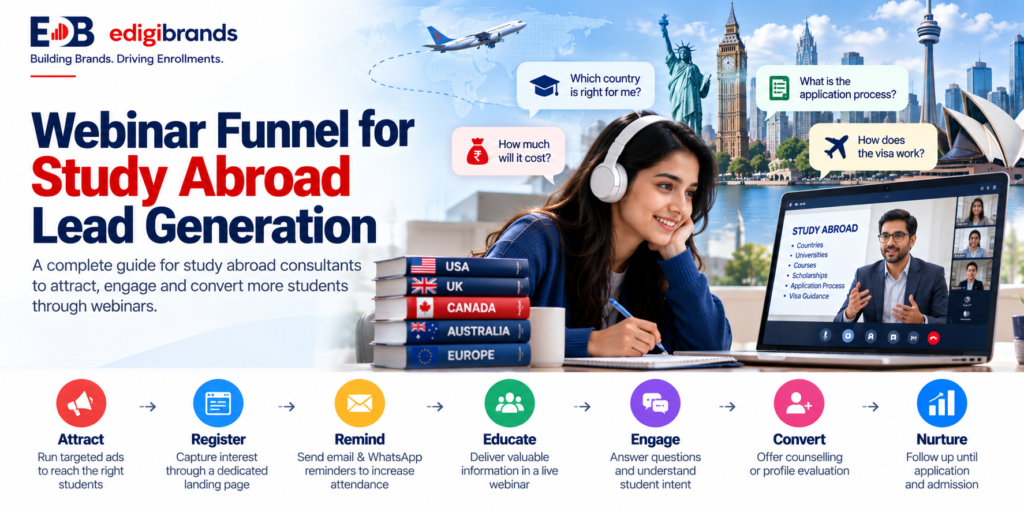
Webinar Funnel for Study Abroad Lead Generation
Study abroad students rarely make decisions after seeing a single advertisement. Before contacting a consultancy, they often want to understand countries, universities, courses, costs, eligibility, applications and career opportunities.
This is where a webinar funnel can become useful.
Instead of asking a student to immediately book a counselling session, a webinar gives your consultancy an opportunity to educate the student, answer questions and build trust before asking for the next step.
A simple webinar funnel can be:
Attract → Register → Remind → Educate → Engage → Follow Up → Counselling
The webinar is only one part of the system. The real value comes from connecting it with your advertising, landing page, WhatsApp, email and follow-up process.
Understanding the Study Abroad Webinar Funnel
What Is a Webinar Funnel?
A webinar funnel is a structured journey that moves a prospective student from initial awareness toward a relevant next step.
For a study abroad consultancy, the journey could look like:
Advertisement → Landing Page → Registration → Reminder → Webinar → Follow-Up → Counselling
The purpose is not simply to collect registrations.
The purpose is to attract students who have a genuine interest in studying abroad and gradually give them the information they need to make a decision.
For example, a student may want to know:
- Which country is suitable for their profile?
- Which course should they choose?
- How much will studying abroad cost?
- Which universities should they consider?
- Which intake should they target?
- What documents are required?
A webinar gives your team enough time to address these questions in a structured way.
This approach also connects with the broader strategy of generating high-quality study abroad leads consistently.
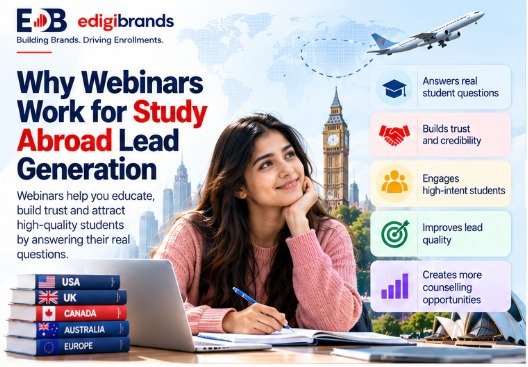
Why Webinars Can Work for Study Abroad Consultants
A normal advertisement has limited space to explain a complicated decision.
A webinar gives you more time to educate.
Instead of simply promoting:
“Study Abroad — Enquire Now”
you can create a specific educational topic such as:
“How to Choose the Right Study Abroad Country for Your Profile”
or
“How to Shortlist Universities Based on Your Academic Profile”
The student immediately understands what they are going to learn.
The webinar should therefore focus on solving a real student problem rather than becoming a long sales presentation.
The Basic Webinar Journey
Each stage of the funnel has a different purpose:
Attract
Reach relevant students through Meta Ads, Google Ads, SEO, social media and other channels.
Register
Send interested students to a dedicated registration page.
Remind
Use appropriate email and WhatsApp communication to increase attendance.
Educate
Deliver useful and practical information during the webinar.
Engage
Answer questions and understand student requirements.
Follow Up
Continue the conversation after the webinar.
Counselling
Give relevant students an opportunity to take the next step.
Building a Study Abroad Webinar Funnel
Choose a Specific Webinar Topic
The first step is choosing a topic that students actually care about.
A generic topic such as “Study Abroad Webinar” may not create a strong reason to register.
Instead, focus on a specific problem.
Examples include:
- How to Choose the Right Study Abroad Country
- How to Shortlist Universities Based on Your Profile
- Study Abroad Budget Planning Guide
- How to Prepare for the Next Intake
- Common Study Abroad Application Mistakes
- How to Choose the Right Course for Your Career
The topic should answer a question that your target student is already asking.
Define Your Target Student
Before promoting the webinar, decide who the webinar is designed for.
Consider:
- Education level
- Preferred country
- Course interest
- Intended intake
- Academic profile
- Approximate budget
- Current decision stage
A useful framework is:
Who are they? → What are they trying to achieve? → What is stopping them? → What information do they need?
This helps prevent the campaign from becoming focused only on registration numbers.
The objective should be to attract relevant students, not simply more registrations.
Create a Dedicated Registration Page
Do not send webinar traffic to your homepage.
Create a dedicated landing page with one clear objective:
Register for the webinar.
The page should clearly communicate:
- Webinar topic
- Date and time
- What students will learn
- Speaker information
- Registration form
- Relevant trust elements
- Confirmation after registration
Keep the registration process simple.
Only ask for information that your team actually needs.
Useful fields may include:
Name → Phone → Email → Education Level → Preferred Country → Course → Intake
The exact fields should depend on how your consultancy qualifies leads.
Build a Reminder System
Registration does not guarantee attendance.
Students may register and forget about the event.
A simple reminder sequence can be:
Immediately: Registration confirmation
1 day before: Webinar reminder
A few hours before: Key reminder
1 hour before: Joining link
The messaging should remain short and useful rather than becoming repetitive promotional messages.
Converting Webinar Interest Into Counselling
Structure the Webinar Around Education
The webinar should have a clear flow.
A simple structure is:
Introduction → Problem → Education → Examples → Q&A → Next Step
Start by explaining what students will learn.
Then discuss the problem they are facing and provide a practical framework or solution.
Use examples wherever possible.
Finally, give students an opportunity to ask questions.
The counselling invitation should come naturally after the educational part rather than dominating the entire session.
Segment Students Based on Engagement
Not every webinar registration represents the same level of intent.
For example:
Registered but did not attend: Share the recording or relevant resources.
Attended but did not engage: Continue educational nurturing.
Engaged students: Share resources based on their interests.
High-intent students: Offer a relevant counselling or profile evaluation opportunity.
This allows your team to communicate differently with students at different stages.
Create a Post-Webinar Follow-Up
The webinar should not end when the presentation finishes.
A simple follow-up sequence could be:
Day 0: Thank-you message and recording
Day 1: Key webinar takeaways
Day 3: Helpful guide or resource
Day 5: Relevant student example
Day 7: Counselling invitation
The objective is not to repeatedly ask students whether they are ready.
The objective is to continue educating them until they are ready for the next step.
This can also support a broader lead nurturing strategy for study abroad consultants.
Connect Email, WhatsApp and Retargeting
A webinar funnel becomes more useful when multiple channels work together.
Email can deliver detailed educational information.
WhatsApp can support reminders and timely communication where appropriate.
Retargeting can reconnect with people who visited the registration page or interacted with your campaign.
For example:
Page Visitor → Webinar Ad
Registered but Absent → Recording
Webinar Attendee → Educational Content
Engaged Student → Counselling Opportunity
This can work alongside a broader retargeting strategy for study abroad leads.
Measuring and Improving the Webinar Funnel
Track the Complete Student Journey
Do not judge a webinar campaign only by the number of registrations.
Track the complete journey:
Registrations → Attendance → Engagement → Counselling → Application → Admission
For example, a campaign with 500 registrations but very little meaningful engagement may require a different analysis from a campaign with fewer registrations but stronger downstream activity.
The important question is:
What happens after the lead is generated?
Turn One Webinar Into Multiple Content Assets
A webinar should not disappear after the live session.
One webinar can become:
- Blog articles
- Instagram carousels
- LinkedIn posts
- Short-form videos
- YouTube videos
- Email content
- FAQs
- Student guides
For example, a webinar about choosing a study abroad country could later become a detailed article, multiple social posts and several short videos.
This gives your marketing team more content without starting from zero every time.
Common Webinar Funnel Mistakes
Avoid these common problems:
- Choosing a topic that is too broad
- Making the webinar too sales-focused
- Collecting unnecessary registration information
- Ignoring reminders
- Treating every lead the same
- Stopping follow-up immediately after the webinar
- Measuring only registrations
- Ignoring what happens after the lead is generated
The webinar should be treated as one part of the complete acquisition and conversion system.
Build a Recurring Webinar Calendar
Instead of conducting one webinar and stopping, create a series around common student questions.
For example:
Webinar 1: Choosing the Right Study Abroad Country
Webinar 2: University Shortlisting Based on Your Profile
Webinar 3: Study Abroad Budget Planning
Webinar 4: Common Application Mistakes
Webinar 5: Preparing for the Next Intake
Each webinar can address a different stage of the student decision-making process.
Over time, this creates an educational content library that can support both lead generation and lead nurturing.
For a broader acquisition perspective, you can also explore Lead Sources of Study Abroad Consultants and Why Most Study Abroad Ads Fail and What Actually Drives Enrollments.
Focus on the Business Outcome
The final objective is not simply to fill a webinar.
The real funnel is:
Registrations → Attendance → Engagement → Counselling → Applications → Admissions
Tracking this journey helps you understand where students are dropping off and where your team needs to improve.
Final Thoughts
A webinar can become more than just an online event for a study abroad consultancy.
When connected with the right acquisition, registration, reminder, engagement and follow-up systems, it can become an educational layer between advertising and counselling.
The framework is simple:
Right Topic → Right Audience → Registration → Education → Engagement → Follow-Up → Counselling
The focus should not be on generating the maximum number of registrations.
It should be on attracting relevant students, educating them effectively and creating a clear path toward the next step.
Consistency also matters. A recurring webinar strategy can create multiple opportunities to reach students at different stages of their study abroad journey.
For more information about Edigibrands, visit Edigibrands or book a strategy call.