
Generating 20 or 30 study abroad leads every month is one challenge. Building a system that can consistently generate hundreds of relevant enquiries without allowing lead quality, follow-up, or conversion to collapse is an entirely different challenge.
Many study abroad consultants try to scale by simply increasing their advertising budget. When the campaign generates 10 leads a day, they assume that doubling the budget should generate 20. Sometimes it does. Often, it creates a different problem: higher costs, lower-quality enquiries, overloaded counsellors, slower follow-ups, and more leads sitting untouched inside the CRM.
The real objective of scaling is not simply more leads.
It is building a repeatable system in which lead sources, targeting, landing pages, follow-ups, counselling, and conversion work together.
This guide explains how study abroad consultants can approach lead generation as a scalable growth system rather than treating every campaign as an isolated advertising exercise.
What Does Scaling Study Abroad Lead Generation Actually Mean?
Scaling study abroad lead generation means increasing the volume of qualified student enquiries while maintaining control over the economics and operational process behind those enquiries.
There are three numbers that matter:
Lead volume → Lead quality → Admissions
A consultancy that generates 1,000 leads but converts very few of them does not necessarily have a successful lead generation system. Likewise, a consultancy generating 30 highly relevant enquiries may have a stronger foundation for growth.
Before increasing your advertising budget, understand where your existing leads are coming from and what happens to them after they enter your system.
For example:
- Which channel generates the most leads?
- Which channel generates the most qualified students?
- Which source produces applications?
- How quickly are new enquiries contacted?
- How many leads become counselling conversations?
- How many counselling conversations become applications?
- Which countries and courses generate stronger demand?
- How many leads are lost because of poor follow-up?
This is why scaling should begin with diagnosis, not advertising spend.
If you are still building your foundation, start by understanding the different lead sources for study abroad consultants. Your objective should be to identify which channels are capable of producing the type of students your consultancy actually wants.
Why Study Abroad Lead Generation Becomes Difficult at Scale
A campaign can work reasonably well at a small budget and still fail when you attempt to scale it.
The reason is simple: growth exposes weaknesses.
At a lower volume, your counsellor may personally remember every enquiry. At a higher volume, that becomes impossible.
At 20 leads a week, manual follow-up may appear manageable. At 200 leads a week, unanswered calls and delayed WhatsApp messages can quickly become a serious operational problem.
Similarly, an ad that works for one audience segment may not continue producing the same results when the audience becomes saturated.
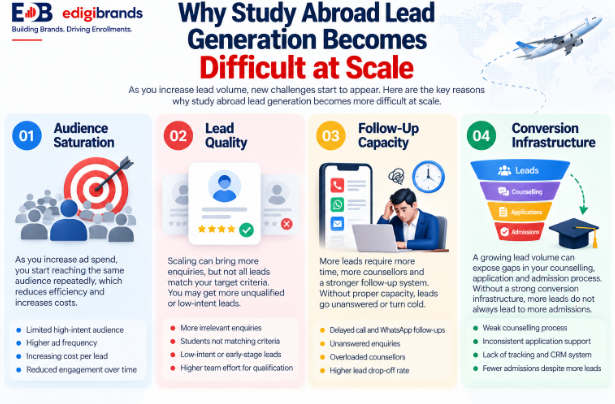
Scaling therefore creates four interconnected challenges.
1. Audience Saturation
Your initial audience may be relatively small. Increasing spend does not automatically create an unlimited supply of relevant students.
You may eventually reach the same people repeatedly, increasing frequency and reducing campaign efficiency.
2. Lead Quality
A broader campaign can increase enquiry volume while also bringing students who do not match your preferred criteria.
For example, your campaign may attract students who:
- Are researching but not ready to apply
- Have unrealistic budgets
- Are interested in countries you do not specialise in
- Do not meet academic requirements
- Are looking for services you do not provide
Therefore, scaling should not be measured only by CPL.
3. Follow-Up Capacity
More leads require more operational capacity.
If your team cannot respond quickly and consistently, increasing lead generation can simply increase the number of leads that go cold.
4. Conversion Infrastructure
A growing consultancy needs a process for moving students from enquiry to counselling, application, documentation and eventually enrollment.
Without this infrastructure, advertising becomes disconnected from revenue.
Step 1: Build a Reliable Lead Generation Foundation
Before scaling, make sure the basic system is working.
Your foundation should include:
Target audience → Offer → Ad → Landing page → Lead capture → CRM → Follow-up → Counselling → Application
If one part is weak, increasing the volume entering the system will expose that weakness.
For example, suppose your advertisements generate 100 leads but the landing page does not clearly communicate your offer. You may have a lead generation problem that is actually caused by a conversion problem.
This is why your first objective should be to create a repeatable acquisition process.
Your study abroad lead generation strategy should be designed around the complete student journey rather than a single advertising campaign.
Step 2: Define the Right Student Before Increasing Volume
One of the most common mistakes consultants make is trying to target “students who want to study abroad.”
That audience is too broad.
A better approach is to create specific audience segments based on factors such as:
- Country preference
- Course or subject
- Undergraduate or postgraduate
- Intake
- Academic background
- Budget
- English-language test status
- Work experience
- Visa requirements
- Current stage in the decision-making process
For example, a student looking for a Master’s program in the UK for the September intake has a very different requirement from a student casually exploring undergraduate opportunities in Canada.
The more clearly you understand these segments, the easier it becomes to create relevant campaigns.
Your advertising message can then match the student’s actual problem.
Step 3: Stop Treating Every Lead the Same
Once your lead volume increases, segmentation becomes critical.
A simple system can divide leads into categories such as:
Hot Leads
Students who are actively planning to apply and are ready for counselling.
Warm Leads
Students who have shown interest but need additional information before taking action.
Future Intake Leads
Students who are interested but are planning for a later intake.
Unqualified Leads
Students who do not currently match your criteria.
Non-Responsive Leads
Students who have submitted an enquiry but have not responded to follow-up attempts.
This segmentation allows your team to prioritise effort.
A counsellor should not spend the same amount of time on a student who is ready to apply next month and someone who is only beginning to research studying abroad.
Step 4: Scale the Channels That Actually Produce Results
There is no universal rule that says every consultancy should scale Meta Ads, Google Ads, SEO or another channel.
Your own data should determine where additional investment makes sense.
A useful framework is:
Source → Leads → Qualified Leads → Counselling → Applications → Admissions
Suppose one channel generates 500 leads but only a small percentage become qualified prospects.
Another channel generates 150 leads but produces significantly more counselling conversations.
Looking only at lead volume could lead you to the wrong conclusion.
This is why why most study abroad ads fail and what actually drives enrollments is an important consideration when building a scalable acquisition system.
The question is not:
“Which channel gives us the cheapest leads?”
The better question is:
“Which channel gives us commercially useful students?”
Step 5: Create Separate Campaigns for Different Intent Levels
A scalable advertising structure should not depend on one campaign targeting everyone.
Consider separating campaigns based on intent.
High-Intent Campaigns
These can target students actively searching for information or services related to study abroad.
Examples include searches around:
- Study abroad consultants
- UK study consultants
- Canada university applications
- Study abroad counselling
- University application assistance
Problem-Aware Campaigns
These campaigns address specific student problems.
Examples:
- How to choose the right university
- How much does studying abroad cost?
- How to evaluate your profile
- Which country is suitable for your career?
Offer-Based Campaigns
These can promote specific actions such as:
- Free profile evaluation
- Counselling session
- University shortlist
- Scholarship assessment
- Application consultation
Retargeting Campaigns
These campaigns re-engage people who have already interacted with your brand.
That might include:
- Website visitors
- Landing-page visitors
- Video viewers
- Social-media engagers
- Previous leads
- Form visitors who did not submit
- Leads who have not yet booked counselling
This creates a more complete acquisition ecosystem instead of relying entirely on cold traffic.
Step 6: Build a Landing Page That Can Handle Scale
If your advertising works, more people will visit your landing page.
That means your landing page becomes an increasingly important part of the acquisition system.
A good landing page should answer three questions quickly:
What do you offer?
Who is it for?
What should the student do next?
Avoid creating one generic landing page for every campaign.
Instead, consider creating landing pages around:
- Country
- Course
- Intake
- Student profile
- Specific service
- Specific campaign offer
Your landing page strategy for study abroad lead generation should connect the advertising message with the student’s next action.
If the advertisement talks about studying in the UK but the landing page presents a generic consultancy message, the transition becomes weaker.
Step 7: Build a Follow-Up System Before Scaling Lead Volume
This is where many lead-generation systems break.
Generating leads is only the beginning.
The lead must then move through a sequence of interactions.
A basic follow-up system can include:
Lead captured → Immediate confirmation → Call → WhatsApp → Email → Counselling → Follow-up → Application
The exact sequence can vary according to your business and audience.
The important point is consistency.
A student may not respond to the first call.
That does not automatically mean the lead has no value.
They may be:
- In class
- At work
- Travelling
- Waiting for parents
- Comparing consultancies
- Waiting for an exam result
- Planning for a future intake
This is why email marketing for study abroad leads and structured WhatsApp follow-ups can complement advertising rather than relying on one phone call.
Step 8: Use Retargeting to Recover Lost Attention
Not every student converts during the first interaction.
Some students visit your website, explore your services and leave.
Others submit an enquiry but do not answer your counsellor.
Some may speak with your team and then disappear while comparing alternatives.
Retargeting gives you another opportunity to communicate with these audiences.
Your retargeting messages can address different stages.
For example:
Website Visitor:
“Still exploring your study abroad options?”
Course Page Visitor:
“Compare universities and course options for your profile.”
Lead Who Did Not Book Counselling:
“Need help understanding your options? Speak with a counsellor.”
Future Intake Lead:
“Planning for the next intake? Start your profile evaluation early.”
The message should reflect what the audience has already done.
Step 9: Introduce CRM-Based Lead Management
As your lead volume grows, spreadsheets and individual WhatsApp conversations become increasingly difficult to manage.
A CRM can help create visibility across the pipeline.
At minimum, your CRM should allow you to track:
| Stage | What to Track |
| New Lead | Source, campaign, date, student details |
| Contacted | Call status and response |
| Qualified | Country, course, intake, profile |
| Counselling | Appointment and outcome |
| Application | Application status |
| Documentation | Pending/completed documents |
| Visa | Visa process status |
| Enrolled | Final outcome |
The purpose of the CRM is not simply storing contact information.
It should help answer:
Where is every lead right now?
Once you can answer that question, you can identify where your funnel is leaking.
Step 10: Measure the Funnel, Not Just CPL
Cost per lead is useful, but it is not enough.
A scalable study abroad acquisition system should monitor several stages.
Cost Per Lead
How much does it cost to generate an enquiry?
Cost Per Qualified Lead
How much does it cost to generate a relevant student?
Cost Per Counselling
How much does it cost to generate an actual counselling conversation?
Cost Per Application
How much does it cost to generate an application?
Cost Per Admission
How much does it cost to generate an admission?
This gives you a much clearer picture of campaign economics.
For example, a campaign with a higher CPL could still be commercially useful if the leads are substantially more qualified and generate more applications.
That is why scaling based purely on CPL can be dangerous.
Step 11: Scale Budgets Gradually
Once you identify a campaign that consistently produces useful leads, resist the temptation to immediately multiply the budget several times over.
Large budget changes can alter delivery, audience reach and campaign performance.
Instead, use a controlled scaling process.
A simple framework is:
Test → Measure → Optimise → Scale → Measure Again
Increase investment when the campaign continues to meet your predefined quality and conversion criteria.
At the same time, monitor:
- CPL
- Lead quality
- Frequency
- Conversion rate
- Counselling rate
- Application rate
- Cost per application
Scaling should be treated as an experiment, not a switch.
Step 12: Expand Horizontally, Not Just Vertically
There are two broad ways to scale.
Vertical Scaling
Increase investment in an existing campaign.
For example:
₹20,000 → ₹30,000 → ₹40,000
Horizontal Scaling
Expand into additional audiences, offers, countries, courses or channels.
For example:
- UK campaign
- Canada campaign
- Australia campaign
- Master’s campaign
- Undergraduate campaign
- Scholarship campaign
- Profile evaluation campaign
Horizontal expansion can reduce your dependence on one audience or campaign.
However, expansion should happen only when the underlying system is capable of handling the additional volume.
Step 13: Build a Multi-Channel Lead Generation System
Long-term growth should not depend entirely on one platform.
A broader acquisition system can combine:
Paid Search + Meta Ads + SEO + Content + Email + WhatsApp + Retargeting + Referrals
Each channel can play a different role.
Search can capture existing intent.
Social advertising can create demand and reach new audiences.
SEO can build organic visibility.
Content can educate students.
Email can nurture existing leads.
WhatsApp can support direct communication.
Retargeting can recover lost attention.
Referrals can bring leads through existing relationships.
The objective is not to be everywhere simply for the sake of being everywhere.
The objective is to build multiple paths through which the right students can discover and engage with your consultancy.
Step 14: Create Content That Supports Lead Generation
Content should not exist separately from your acquisition strategy.
Every major student question can become an opportunity to attract and educate potential leads.
For example:
Country Content
- UK vs Canada for international students
- Best countries for specific courses
- Cost of studying abroad
Course Content
- Best universities for MBA
- Career opportunities after a specific course
- Course eligibility
Decision Content
- How to shortlist universities
- How to calculate study abroad costs
- How to evaluate your profile
Conversion Content
- Student success stories
- Application guides
- Counselling FAQs
- Documentation checklists
This approach allows your consultancy to become a source of information rather than appearing only when someone is ready to buy.
Step 15: Improve Lead Quality Before Increasing Volume
This is one of the most important principles in scaling.
If your existing campaigns generate poor-quality leads, increasing the budget may simply generate more poor-quality leads.
Before scaling, examine:
- Targeting
- Ad messaging
- Lead form questions
- Landing page copy
- Offer
- Country targeting
- Course targeting
- Qualification criteria
- Follow-up process
You can also add qualifying questions to your forms.
For example:
- Preferred country
- Preferred course
- Current qualification
- Intake
- Approximate budget
- English test status
The objective is not to make the form unnecessarily difficult.
The objective is to collect enough information to distinguish relevant prospects from low-intent enquiries.
The Scaling Framework for Study Abroad Consultants
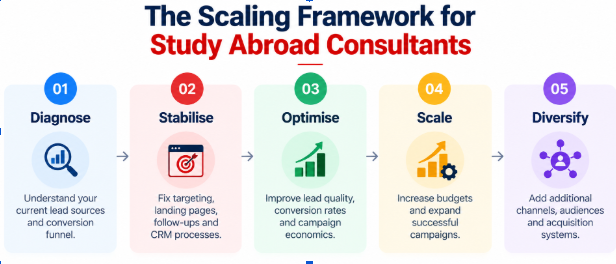
A practical scaling framework can be simplified into five stages:
1. Diagnose
Understand your current lead sources and conversion funnel.
2. Stabilise
Fix targeting, landing pages, follow-ups and CRM processes.
3. Optimise
Improve lead quality, conversion rates and campaign economics.
4. Scale
Increase budgets and expand successful campaigns.
5. Diversify
Add additional channels, audiences and acquisition systems.
This approach is more sustainable than simply increasing ad spend every time lead volume drops.
Common Mistakes When Scaling Study Abroad Leads
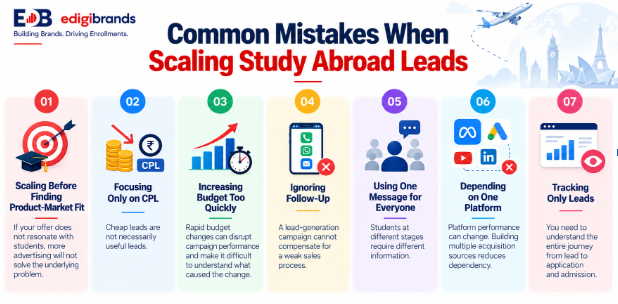
Scaling Before Finding Product-Market Fit
If your offer does not resonate with students, more advertising will not solve the underlying problem.
Focusing Only on CPL
Cheap leads are not necessarily useful leads.
Increasing Budget Too Quickly
Rapid budget changes can disrupt campaign performance and make it difficult to understand what caused the change.
Ignoring Follow-Up
A lead-generation campaign cannot compensate for a weak sales process.
Using One Message for Everyone
Students at different stages require different information.
Depending on One Platform
Platform performance can change. Building multiple acquisition sources reduces dependency.
Tracking Only Leads
You need to understand the entire journey from lead to application and admission.
When Should You Actually Scale?
Do not scale simply because you generated a large number of leads last month.
Look for evidence that your system is becoming repeatable.
Before scaling, ask:
Is the campaign consistently generating relevant leads?
Can the sales team handle additional enquiries?
Are follow-ups happening consistently?
Is the CRM accurately tracking the pipeline?
Are counselling conversations increasing?
Are applications being generated?
Do you understand your cost per application?
If these numbers are not visible, scaling becomes guesswork.
Final Thoughts: Build a Lead System, Not Just a Lead Campaign
The biggest shift a study abroad consultancy can make is moving from campaign thinking to system thinking.
A campaign asks:
“How many leads can we generate this month?”
A growth system asks:
“How can we consistently attract the right students, nurture them, move them into counselling, and convert qualified prospects into applications?”
That difference becomes increasingly important as your consultancy grows.
Scaling study abroad lead generation is therefore not simply about spending more money on Meta Ads or Google Ads. It involves connecting targeting, offers, content, landing pages, CRM, follow-up, retargeting and counselling into one measurable process.
If you are already generating leads but struggling to turn them into applications, review your entire funnel before increasing your advertising budget. Your next growth opportunity may not be another campaign—it may be fixing the gap between the lead and the admission.
For a broader understanding of sustainable acquisition, you can also explore why consistency matters more than budget in study abroad lead generation.
And if you want to understand how to improve the quality of your existing acquisition system, see how to generate high-quality study abroad leads consistently.
The goal is simple:
More qualified students.
Better follow-up.
More applications.
A lead-generation system that can actually scale.
For businesses looking to build technology around their education operations, you can also explore Edigibrands’ EdTech product solutions.
If you want to discuss your current lead-generation system and identify where the biggest gaps are, you can book a strategy call or contact Edigibrands