
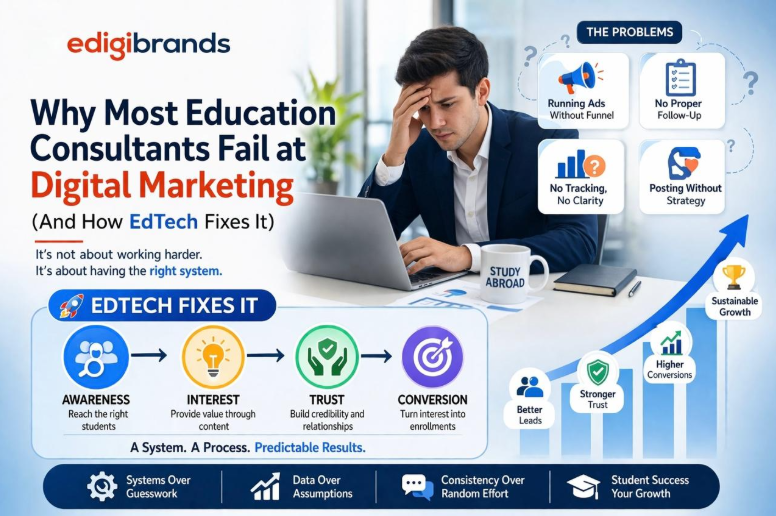
Why Most Education Consultants Fail at Digital Marketing (And How EdTech Fixes It
🌍 The Reality Most Consultants Experience
If you sit down with most education consultants and ask them about digital marketing, the answer is usually mixed.
Some will say:
👉 “We tried ads, but results didn’t last.”
👉 “We post content, but no serious inquiries come.”
👉 “Leads come, but they don’t convert.”
At first glance, it feels like the problem is marketing itself.
But if you look deeper, the issue is not marketing.
👉 It’s the way marketing is being done.
📉 Effort is There — But Direction is Missing
Most consultants are not lazy. In fact, they are trying multiple things:
- Running Facebook or Google ads
- Posting on Instagram
- Responding to inquiries
- Talking to students
But everything feels disconnected.
There is no flow.
One day leads come in.
The next day, nothing happens
👉 This creates frustration — because effort is high, but results are unstable.
🔍 The Core Problem: No System
Here’s the truth that many overlook:
Digital marketing without a system is just noise.
When there is no structure:
- Ads bring random traffic
- Content doesn’t build trust
- Leads are not nurtured
- Follow-ups are inconsistent
👉 And eventually, everything feels like a waste.
This is why many consultants start strong… and then stop.
📱 How Student Behavior Has Changed
At the same time, students have completely changed how they make decisions.
Earlier, a student might visit a consultant’s office and ask questions directly.
Now, the process is very different.
A student will:
- Search online for countries and courses
- Watch multiple videos
- Compare consultants
- Read reviews
- Take time before contacting anyone
👉 By the time they reach you, they are already informed
Which means:
You are no longer their first source of information —
you are their final decision point.
💡 Why Traditional Marketing Fails Here
This is where most consultants struggle.
They try to apply old methods in a new environment.
For example:
- Running ads without explaining value
- Posting random content without clarity
- Expecting quick conversions
But today’s students don’t convert instantly.
They observe first.
They trust slowly.
👉 And then they decide.
⚙️ How EdTech Brings Structure
This is where EdTech changes everything.
Not in a complicated way — but in a practical way.
It introduces a system.
Instead of random activities, it creates a journey:
👉 Awareness → Interest → Trust → Conversion
Each stage has a purpose.
Each step supports the next.
📥 Step 1: Attracting the Right Students
The first goal is not just visibility — it’s relevant visibility.
You want students who are:
- Interested in studying abroad
- Actively researching
- Open to guidance
This is done through:
- Search-based content
- Informational posts
- Targeted campaigns
👉 Not everyone is your audience — and that’s okay.
📢 Step 2: Building Trust Before the First Call
This is the most underrated step.
Students don’t trust instantly anymore.
They observe:
- How you explain things
- How consistent you are
- How clearly you communicate
This is where content becomes powerful.
If you want to understand this deeper, you can explore how modern education consulting systems work and how they help build trust even before a conversation begins.
📲 Step 3: Nurturing Leads Properly
Many consultants lose leads not because they are bad —
but because they are not followed up properly.
A student might:
- Show interest today
- Think for a few days
- Contact someone else
👉 This happens when there is no structured follow-up.
With proper systems:
- Every lead is tracked
- Communication is timely
- Students feel guided
🎯 Step 4: Focusing on Quality Over Quantity
One of the biggest mistakes is chasing numbers.
More leads don’t always mean more admissions.
In fact, too many unqualified leads create:
- Time waste
- Confusion
- Lower conversion
👉 The real goal is accuracy.
If you look closely, understanding how we get most accurate leads shows why targeted students convert much faster than random inquiries.
⚠️ Why Many Consultants Still Feel Stuck
Even after trying multiple strategies, many consultants feel stuck.
Because they are:
- Doing too many things
- Without a clear direction
- Without consistency
👉 It’s not about doing more — it’s about doing the right things in order.
🧠 The Mindset Shift That Changes Everything
Instead of asking:
👉 “Which ad should I run?”
👉 “What content should I post?”
Start asking:
👉 “Do I have a system that guides a student from first click to final admission?”
This single shift creates clarity.
And clarity creates results.
📈 What Growing Consultants Are Doing Differently
Consultants who are growing today are not necessarily working harder.
They are working smarter.
They focus on:
- Systems over shortcuts
- Consistency over spikes
- Process over guesswork
If you want to know how we work, it becomes clear that growth is not random — it is designed.
📌 Final Thoughts
Digital marketing is not failing.
The approach is.
When used without structure, it feels unpredictable.
But when supported by systems:
✔ Leads become consistent
✔ Trust builds naturally
✔ Conversions improve steadily
🔥 Soft Closing
Take a step back and look at your current setup.
Not your effort —
but your structure.
Because in today’s world:
👉 Systems don’t just support growth — they define it.