
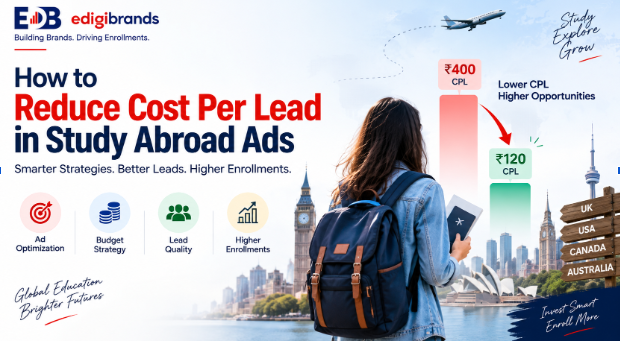
Getting more study abroad leads is not always the real challenge. The bigger challenge is getting those leads at a cost that makes sense for your consultancy.
Many study abroad consultants look at their advertising dashboard and focus on one number: Cost Per Lead (CPL). When CPL increases, the first reaction is often to reduce the budget, change the campaign, or switch platforms. But a high CPL is not always caused by the advertisement itself. The real issue may be poor targeting, weak messaging, low-quality traffic, an ineffective landing page, or a follow-up process that does not convert the leads being generated.
The right way to approach this is to look at the complete journey:
Ad → Lead → Qualification → Follow-Up → Counselling → Application → Enrollment
If you optimize only the first step, you may reduce CPL while also reducing lead quality. If you optimize the complete system, you can work toward a lower acquisition cost while generating students who are more likely to move toward enrollment.
In this guide, we will look at practical ways to reduce CPL in study abroad ads without blindly reducing your advertising budget.
What Is Cost Per Lead in Study Abroad Marketing?
Cost Per Lead is the amount you spend on advertising to generate one lead.
For example, if you spend ₹50,000 on advertising and generate 500 leads, your CPL is ₹100.
However, this number alone does not tell you whether your campaign is successful.
Suppose Campaign A generates leads at ₹80 each, while Campaign B generates leads at ₹150 each. At first glance, Campaign A looks better. But if Campaign A produces mostly unqualified inquiries while Campaign B generates serious students who attend counselling, Campaign B may actually be more valuable.
This is why study abroad consultants should not look at CPL in isolation. You also need to consider lead quality, connected calls, counselling appointments, applications and final enrollments.
Why Your Study Abroad CPL May Be Increasing

There can be several reasons behind an increasing CPL. Sometimes the issue is related to the advertising platform, but in many cases, it is connected to the broader marketing system.
Common reasons include:
- Poor audience targeting
- Increasing competition
- Weak ad creatives
- Generic advertising messages
- Low-quality landing pages
- Poor offer positioning
- Too many irrelevant leads
- Limited campaign testing
- High audience overlap
- Poor follow-up after lead generation
Before changing your budget, first identify where the actual problem is.
A useful way to think about this is through three questions:
Are the right students seeing the ad?
Are they interested enough to submit their details?
Are the generated leads actually moving toward counselling and enrollment?
The answers will tell you what needs to be optimized.
1. Start With Lead Quality, Not Just Lead Volume
One of the biggest mistakes in study abroad advertising is treating every lead as equally valuable.
A lead who has casually clicked an advertisement is not necessarily equivalent to a student who has already decided to study abroad and is actively looking for counselling.
If you optimize your campaign only for the lowest possible CPL, the advertising platform may find users who are more likely to submit forms but are not necessarily serious about studying abroad.
This creates a common situation:
Lower CPL → More leads → More unqualified leads → More follow-up work → Fewer conversions
Instead, your goal should be:
Better targeting → Better lead quality → Better conversations → More applications → More enrollments
Your student lead quality strategy should therefore be considered alongside your advertising strategy.
The objective is not simply to generate the maximum number of leads. The objective is to generate the right leads at an economically sustainable cost.
2. Improve Your Audience Targeting
Audience targeting has a direct impact on both lead volume and lead quality.
If your campaign targets a very broad audience without considering student intent, you may generate a large number of inquiries from people who are only exploring the idea of studying abroad.
A more focused approach can include factors such as:
- Study destination
- Preferred course
- Education level
- Graduation status
- Study-abroad intent
- Relevant interests
- Geographic location
- Previous website engagement
- Video engagement
- Existing customer or lead data
For example, instead of creating one generic campaign for everyone interested in studying abroad, you can create separate campaigns around specific destinations or student requirements.
A student looking for a master’s degree in the UK may respond very differently to an advertisement targeting a student interested in undergraduate education in Australia.
The more relevant your message is to the audience, the easier it becomes to improve both engagement and lead quality.
3. Do Not Use the Same Ad for Every Student
A common mistake is creating one advertisement and running it continuously for months.
Students have different questions depending on where they are in their decision-making process.
Someone who has just started exploring international education may need basic information, while someone who has already shortlisted universities may be looking for application support, fees, scholarships or visa guidance.
Your advertising should reflect these differences.
For example:
Awareness-Focused Message
Thinking About Studying Abroad?
Understand your options, destinations and courses before making your decision.
Consideration-Focused Message
Not Sure Which Country Is Right for You?
Compare universities, costs, courses and career opportunities with expert guidance.
High-Intent Message
Already Shortlisted Your University?
Get professional guidance for your application and next steps.
Different messages allow you to reach students at different stages instead of forcing every prospect into the same advertising journey.
This also connects with your broader study abroad lead generation strategy.
4. Improve Your Ad Creative Before Increasing Your Budget
Sometimes CPL increases because the audience has simply stopped responding to the same creative.
If students repeatedly see the same image, headline or video, engagement can decline. When this happens, advertising costs can increase.
Instead of immediately increasing the budget, test different creative angles.
You can test:
- Student success stories
- Country-specific opportunities
- University comparison content
- Scholarship information
- Cost-related content
- Career outcomes
- Student testimonials
- Common application mistakes
- Visa-related educational content
- Free profile evaluation offers
The goal is not to make every advertisement completely different. The goal is to identify which message creates the strongest response from your target student audience.
For consultants running Meta campaigns, your Facebook Ads strategy for study abroad should include continuous creative testing rather than relying on one advertisement for an extended period.
5. Make the Offer Stronger
Students do not submit their details simply because you are running an advertisement.
They need a reason to take action.
A generic message such as:
“Contact us for study abroad counselling.”
may not be strong enough to differentiate your consultancy from dozens of competitors.
Instead, you can build a more specific offer around the student’s immediate problem.
For example:
- Free profile evaluation
- Free university shortlist
- Country comparison guide
- Free application eligibility check
- Scholarship eligibility assessment
- Course selection consultation
- Study-abroad cost calculator
- Free counselling session
The offer should provide enough value for the student to feel that sharing their information is worthwhile.
The stronger the alignment between student problem → ad message → offer, the better your chances of generating relevant leads.
6. Fix Your Landing Page
If you are sending students from an advertisement to a landing page, your landing page can have a major impact on your overall acquisition cost.
Imagine spending money to bring a student to your website and then presenting them with a confusing page, too much information, a weak headline or a form that asks for unnecessary details.
You have already paid for the traffic, but the page is preventing the traffic from becoming a lead.
A good landing page should clearly communicate:
- What you offer
- Who the service is for
- Why the student should trust you
- What the student gets
- What action they should take
You can learn more through our landing page strategy for study abroad lead generation.
Remember, reducing CPL does not always mean reducing the advertising cost. Sometimes it means converting more of the traffic you are already paying for.
7. Do Not Optimize for Cheap Leads at the Cost of Quality
This is one of the most important points for study abroad consultants.
Suppose you have two campaigns:
| Campaign | CPL | Leads | Qualified Leads |
| Campaign A | ₹80 | 500 | 50 |
| Campaign B | ₹130 | 300 | 90 |
Campaign A appears cheaper.
But Campaign B produces more qualified leads despite having a higher CPL.
If those qualified leads are more likely to attend counselling and apply, Campaign B may produce a significantly better business outcome.
Therefore, your dashboard should not stop at CPL.
Track:
CPL → Connected Leads → Qualified Leads → Counselling → Applications → Enrollments
This gives you a much more realistic view of campaign performance.
8. Improve Your Lead Follow-Up
A lead that is generated but never properly followed up is a wasted advertising opportunity.
This is particularly important in study abroad marketing because students often need time before making a decision. They may compare multiple consultancies, speak with parents, research universities and consider their financial options before committing.
Your job does not end when the student submits a form.
Your follow-up system should help you:
- Respond quickly
- Understand the student’s requirements
- Share relevant information
- Answer objections
- Maintain communication
- Remind students about important next steps
- Move interested students toward counselling
This is where WhatsApp automation for study abroad leads can become useful.
Automation can help with initial communication and reminders, while your team can focus on meaningful conversations and counselling.
9. Use Retargeting Instead of Always Looking for New Audiences
Not every student who sees your advertisement will convert immediately.
Some may visit your website, watch your video, interact with your social media profile or open your content without submitting an inquiry.
That does not necessarily mean they are uninterested.
They may simply need more information.
Retargeting allows you to communicate with people who have already interacted with your brand.
For example:
First interaction: Student watches a video about studying in the UK.
Second interaction: Student sees a university comparison guide.
Third interaction: Student receives an invitation for a profile evaluation.
This creates a more structured journey instead of expecting one advertisement to generate an immediate conversion.
10. Test Your Campaign Instead of Making Random Changes
A campaign should not be changed every day simply because the results fluctuate.
When you change multiple elements at the same time, it becomes difficult to understand what actually improved or damaged performance.
Instead, create controlled tests.
You can test:
Audience A vs Audience B
Creative A vs Creative B
Offer A vs Offer B
Landing Page A vs Landing Page B
Broad targeting vs focused targeting
Give each test enough time and data to produce a meaningful comparison.
The goal is to build a repeatable advertising system rather than depending on random campaign changes.
11. Control Your Budget Based on Performance
Budget management is not simply about spending less.
If a campaign is producing high-quality leads and those leads are converting into applications, reducing the budget too aggressively may limit your growth.
At the same time, continuing to spend heavily on a campaign that generates poor-quality leads can increase your overall acquisition cost.
A better approach is to divide campaigns based on performance.
High-performing campaign: Scale carefully.
Average-performing campaign: Continue testing and optimize.
Poor-performing campaign: Diagnose the problem before spending more.
Your goal should be to understand where every additional ₹1,000 of advertising spend is producing the strongest business outcome.
12. Measure Cost Per Enrollment, Not Just Cost Per Lead
This is where the real business picture becomes clear.
Imagine you spend ₹1,00,000 and generate 1,000 leads.
Your CPL is ₹100.
That sounds good.
But if only two students enroll, your acquisition cost per enrollment is ₹50,000.
Now imagine another campaign spends ₹1,00,000 and generates 500 leads at ₹200 CPL.
The CPL looks worse.
But if 10 students enroll, your acquisition cost per enrollment is ₹10,000.
The second campaign is clearly more valuable from a business perspective.
This is why the final metric should move beyond:
“How much does one lead cost?”
and toward:
“How much does one enrollment cost?”
That shift in thinking can completely change how you manage your advertising budget.
A Simple Framework to Reduce CPL Without Reducing Growth
Instead of randomly changing your campaigns, follow this sequence.
Step 1: Diagnose
Find out whether the problem is audience, creative, offer, landing page or follow-up.
Step 2: Improve Lead Quality
Define what a good student lead looks like before trying to increase lead volume.
Step 3: Test Creatives
Create different messages and creative formats for different student segments.
Step 4: Improve Conversion
Make your landing page, forms and offers easier to understand.
Step 5: Strengthen Follow-Up
Respond quickly and maintain communication with interested students.
Step 6: Measure the Funnel
Track leads, connected calls, qualified leads, counselling, applications and enrollments.
Step 7: Scale What Works
Move more budget toward campaigns that produce strong business outcomes rather than simply low CPL.
The Real Goal Is Not the Lowest CPL
The lowest possible CPL is not necessarily the best result for a study abroad consultancy.
A ₹70 lead that never answers your call is less valuable than a ₹150 lead who attends counselling, submits documents and eventually enrolls.
Your advertising strategy should therefore focus on the complete acquisition system.
Better targeting creates better leads.
Better messaging creates stronger interest.
Better landing pages create more inquiries.
Better follow-up creates more opportunities.
Better conversion systems create more enrollments.
This is why study abroad lead generation should never be treated as simply running advertisements. It is a complete process that connects visibility, lead generation, nurturing and conversion.
For a broader perspective on why advertising performance cannot be separated from the overall enrollment journey, read Why Most Study Abroad Ads Fail and What Actually Drives Enrollments.
You can also explore why consistency matters more than budget in study abroad lead generation when building a sustainable acquisition system.
Final Thoughts
If your study abroad CPL is increasing, do not immediately assume that you need to spend more money or switch advertising platforms.
First, diagnose the complete funnel.
Look at the quality of the leads. Check whether your advertisements are reaching the right students. Review your creatives and offers. Examine your landing page. Study your response and follow-up process. Most importantly, compare campaigns based on qualified leads, applications and enrollments rather than CPL alone.
The strongest study abroad marketing systems are not built around getting the cheapest possible lead. They are built around creating a predictable path from advertisement to qualified student to enrollment.
When you optimize the entire system, reducing CPL becomes part of a bigger objective: getting more qualified students and generating more enrollments from the budget you already have.
If you want to understand how edigibrands approaches lead generation and growth, you can explore the edigibrands EdTech Product or learn more about edigibrands.
For a discussion about your current lead generation system, contact edigibrands or book a strategy call.