
In the bustling world of overseas education consultancy, especially in a vibrant market like India, the competition is fierce. Every day, countless students and their parents scroll through websites, social media feeds, and advertisements, all promising to pave the way to a top international university. But what makes them stop scrolling and choose you? It’s not just the list of partner universities or the promise of a quick visa. It’s trust. This article will show you exactly how to build trust with study abroad students online, transforming skeptical prospects into confident enrollees. The core of your success lies not in shouting the loudest, but in building a foundation of genuine credibility and connection.
The digital landscape is a double-edged sword. While it gives you unprecedented reach, it’s also filled with noise, misinformation, and frankly, some untrustworthy players. For students and their families making one of the most significant financial and life decisions, skepticism is a natural defense mechanism. They’re asking themselves: Is this consultancy legitimate? Will they handle my application with care? Are they just after my money? Overcoming this initial doubt is the first and most critical hurdle. Without trust, even the most attractive study destination or university offering will fall on deaf ears.
The Foundation: Establishing Unshakeable Credibility
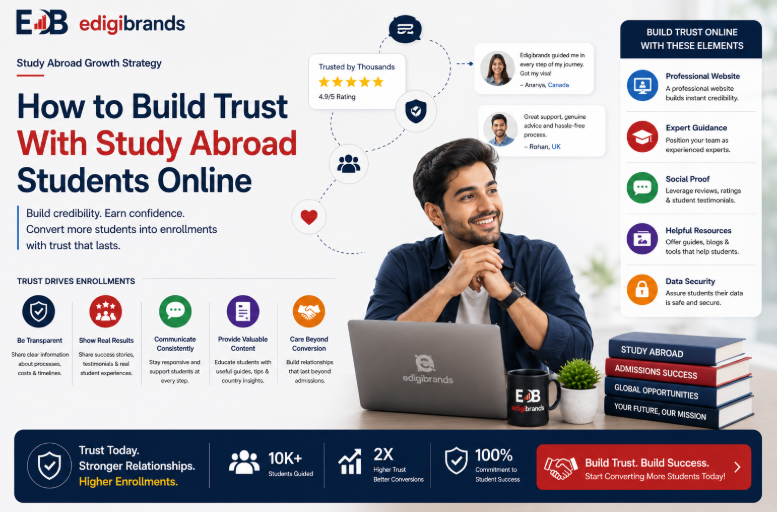
Before you can even think about specific tactics, you need a solid foundation. Credibility isn’t built overnight, but it is built intentionally. It starts with professionalism in every digital interaction. Your brand’s online presence is your virtual office, and it needs to be impeccable. This means a clean, professional website, consistent branding across all channels, and prompt, clear communication. Your ability to present a unified and dependable front is a cornerstone of your student trust strategy.
A critical aspect of building this credibility is consistency. Sporadic posting, a neglected website, or an outdated blog sends a message of unreliability. As we have discussed before, consistency in lead generationmatters more than a huge budget because it demonstrates commitment and stability. When students see you consistently providing value and maintaining a professional presence, they begin to see you as a stable partner for their long and important journey.
Your Digital Handshake: The Power of a Professional Website
Your website is often the first point of contact a student has with your brand. It’s your digital handshake, and it must be firm and confident. A poorly designed, slow, or confusing website is an immediate red flag. To build trust, your website must be:
- Professionally Designed: It should look modern, clean, and reflect the high standards of the universities you represent. Good design implies professionalism.
- Easy to Navigate: Students should be able to find information about your services, partner universities, and success stories effortlessly. A confusing site structure leads to frustration, not trust.
- Mobile-First: The vast majority of students in India will access your site on their mobile phones. If your site isn’t optimized for mobile, you’re losing credibility before you’ve even had a chance to earn it.
- Full of Clear Information: Your service offerings, processes, and contact details must be crystal clear. Include a visible address and phone number, like our office line 9673019894, to show that you are a real, accessible business. Make it easy for them to contact you, not a puzzle to be solved. If you want to know more about the common pitfalls, it’s worth understanding why students don’t choose your consultancy even when your services are excellent—often, the website is the culprit.
Leveraging Social Proof: The Magic of Testimonials
One of the most powerful tools in your arsenal for learning how to build trust with study abroad students online is social proof. When you say you’re great, it’s marketing. When a former student says you’re great, it’s proof. High-quality testimonials are non-negotiable. They provide a relatable, human element that no corporate brochure can match. Seeing someone just like them who has successfully navigated the process with your help is immensely reassuring.
Your strategy for collecting and displaying testimonials should be a priority. Consider:
- Video Testimonials: A short video of a happy student sharing their story is gold. It’s authentic, engaging, and hard to fake. Encourage students to talk about their initial fears and how you helped them overcome them.
- Detailed Written Reviews: Go beyond “They were great!” and encourage students to write detailed reviews on platforms like Google My Business and niche education portals. A detailed story about the visa process or university selection is far more convincing.
- Case Studies: Transform your best success stories into detailed case studies. Outline the student’s initial goal, the challenges they faced, and how your consultancy provided a specific solution that led to their admission.
- Social Media Mentions: Feature screenshots of positive comments and mentions from your social media channels. This shows real-time positive feedback and engagement.
This focus on authentic student voices is a key part of an effective student trust strategy. It shows you have a track record of success and care about the outcomes of the students you work with, which is a powerful message that resonates deeply with both students and their parents.
A Masterful Student Trust Strategy: Transparency and Communication
Trust is a two-way street built on a bridge of transparency. In a field where hidden costs and vague promises can be common, being upfront is a revolutionary act. A transparent student trust strategyinvolves being honest about everything, from your fee structure to the realities of studying in a new country. Students are smart; they can spot a sales pitch from a mile away. What they crave is genuine guidance.
Provide immense value for free. Create blog posts, guides, and webinars that answer their most pressing questions without asking for anything in return. For example, explaining why most study abroad ads fail shows you understand the market and are willing to share insights, positioning you as an expert, not just a service provider. The more you educate, the more you build authority and credibility.
Effective communication practices include:
- Setting Clear Expectations: Be clear about the entire process, timelines, and what is required from the student at each stage.
- Being Responsive: Answer emails and messages promptly. A quick response shows you are attentive and value their time.
- Proactive Updates: Don’t wait for students to ask for an update on their application. Proactively keeping them in the loop builds confidence and reduces anxiety.
- Honesty About Challenges: If a particular visa process is known to be difficult or a student’s profile is a long shot for a certain university, be honest about it. They will trust you more for your honesty than for a false promise.
Mastering how to build trust with study abroad students online really boils down to treating each prospect as a person, not a lead. Are you ready to refine your approach and build a brand that students and parents implicitly trust? Book a free strategy call with Edigibrands today! We can help you implement these strategies effectively.
The Role of Branding in Securing Trust
Finally, let’s talk about branding. Your brand is the complete picture that a student forms of your consultancy. It’s your logo, your website’s design, your tone of voice on social media, and the content you share. A strong, consistent brand acts as a mental shortcut for trust. When every touchpoint is professional and aligned, it screams reliability.
Think of major brands you trust. Their consistency is a key reason for that trust. Your consultancy must adopt the same mindset. Your brand message should focus on your values—perhaps it’s your commitment to personalised service, your expertise in a specific country, or your high success rate. Whatever it is, communicate it consistently. This consistent branding is directly linked to your ability to generate high-quality study abroad leads, as a trustworthy brand naturally attracts more qualified and serious applicants.
Here at Edigibrands, we empower consultancies by providing them with the tools and strategies to build such powerful brands. You can learn more about our mission and values by finding out more about Edigibrands. By focusing on a holistic online presence, you are not just marketing your services; you are building a reputation that precedes you, making the process of how to build trust with study abroad students online an integrated part of your business operations. Explore Edigibrands’ edtech solutionsto see how technology can further streamline this process.
Q: How can I get authentic testimonials from students?
A: The best way is to ask at the peak of their happiness—right after they get their visa or admission letter! Make the process easy for them. Send a simple email with a direct link to your Google review page or a short form. For video testimonials, you can offer a small gift card as a thank you for their time. Authenticity is key, so never script their responses.
Q: Is a fancy website really necessary to build trust?
A: It doesn’t need to be ‘fancy’ or expensive, but it must be ‘professional’. This means it should be clean, mobile-friendly, fast-loading, and free of errors. A simple, well-structured website from a platform like WordPress can build more trust than a flashy but broken site. Its main job is to prove your legitimacy and make information easily accessible.
Q: How quickly can I build trust with a new online audience?
A: Building deep trust takes time and consistency. However, you can establish initial credibility quickly with a professional website, strong social proof (even just a few powerful testimonials), and transparent, valuable content. Think of it in layers. Foundational trust can be built in weeks, but deep, brand-loyal trust is built over months of consistent positive interactions.
Q: What’s the biggest mistake consultancies make that erodes trust?
A: Inconsistent communication is one of the biggest trust-killers. Going silent for weeks after receiving documents, not responding to queries, or providing vague, non-committal answers creates anxiety and suspicion. Prompt, clear, and proactive communication is paramount in demonstrating that you are a reliable partner.
Q: Should I be active on all social media platforms to build credibility?
A: No. It’s better to be highly active and engaged on one or two platforms where your target audience (students) spends their time—like Instagram and YouTube—than to have a weak presence on five or six. Choose your platforms wisely, and focus on creating high-quality, valuable content and engaging with your community there. Quality trumps quantity when it comes to building a trustworthy online presence.