

Introduction
Choosing the right study abroad intake is an important part of planning an international education. Universities may admit students in different cycles during the year, commonly called fall, spring and summer intakes. Each cycle can differ in start month, course availability, application deadlines, scholarships and preparation time.
There is no universally best intake. The right option depends on the country, university, course, academic readiness, budget, scholarship plans and visa preparation. Start with the course you want to study, then confirm which intakes are available for that programme.
Education consultancies supporting applicants can also explore EdigiBrands’ EdTech Product for information about consultancy-focused technology.
1. What Are Study Abroad Intakes?
A study abroad intake is the period when a university begins a new academic term and admits a new group of students. Institutions may use semesters, trimesters, quarters or programme-specific start dates. Fall, spring and summer are common labels, but their exact months and availability differ by country and university.
A fall intake at one university may begin in August, while another may begin in September. Some programmes are available only once a year. Always confirm the course start date and application deadline on the official university website.
2. Fall Intake: Meaning, Timeline and Features
The fall intake generally begins around August or September in many universities, particularly in the United States and Canada. In some other destinations, the main academic year begins around September or October. It is a major admission cycle at many institutions, but the range of available courses varies.
Why students consider fall
Many universities offer a broad range of undergraduate and postgraduate programmes during their main academic-year entry.
Some scholarships and funding opportunities align with this cycle, although they may have earlier deadlines.
Students may join the largest incoming cohort and follow the standard academic calendar.
Orientation, campus activities and recruitment events may be organised around the main intake.
Potential limitations
Competition can be high for popular courses and scholarships.
Applications may need to be prepared many months in advance.
Popular programmes can close once places are filled.
Students who are not ready with documents or test results may need a later intake.
Fall may suit students who have completed their previous qualification, can prepare a complete application on time and have identified a course that accepts fall entry.
3. Spring Intake: Meaning, Timeline and Features
The spring intake commonly begins around January or February, depending on the institution. It can offer another entry opportunity to students who missed a fall deadline or need more time to complete academic requirements.
Why students consider spring
An additional entry point at universities offering both fall and spring admission.
More time to complete tests, collect documents or arrange finances after the fall cycle.
An opportunity to start sooner than waiting for the next fall intake, if the preferred course is available.
Potential limitations
Not every university or course offers a spring start.
The programme selection may be narrower than fall at some institutions.
Scholarships or assistantships may be limited to selected entry terms.
Module sequencing, internships or graduation plans may be affected by a later start.
Spring may suit students who need additional preparation time and have confirmed that their chosen course accepts January or February entry. Check whether required first-semester modules are available.
4. Summer Intake: Meaning, Timeline and Features
The summer intake often begins around May, June or another summer period. It is generally less widely available for full-degree programmes than fall or spring, although some institutions offer selected courses, pathway programmes or specialised academic options.
Why students consider summer
An additional start date where the exact programme is offered.
A possible fit for students whose academic or personal timelines do not align with fall or spring.
Selected pathway or short-course options may be available.
Potential limitations
Fewer full-degree programmes may be available.
Scholarships may be more limited or follow different schedules.
Course sequencing and campus activity may differ from the main academic-year intake.
Some summer options may be short courses rather than entry to a full degree.
Before selecting summer, confirm that the exact university and course officially offer that entry point and that it leads to the qualification you intend to pursue.
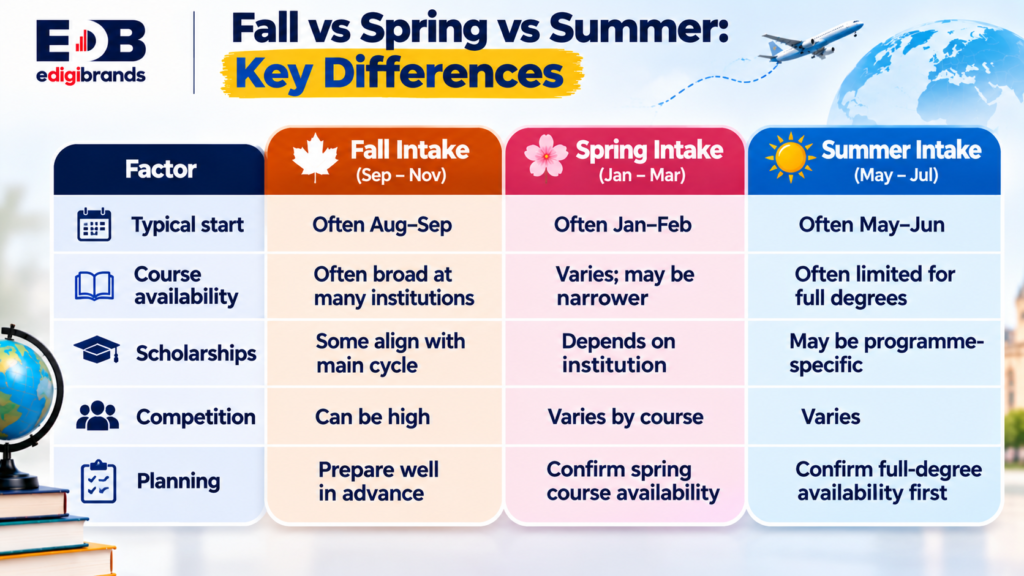 5. Fall vs Spring vs Summer: Key Differences
| Factor | Fall | Spring | Summer |
| Typical start | Often Aug–Sep | Often Jan–Feb | Often May–Jun |
| Course availability | Often broad at many institutions | Varies; may be narrower | Often limited for full degrees |
| Scholarships | Some align with main cycle | Depends on institution | May be programme-specific |
| Competition | Can be high | Varies by course | Varies |
| Planning | Prepare well in advance | Confirm spring course availability | Confirm full-degree availability first |
This is a general comparison, not a guarantee. Each university defines its own calendar, course list, scholarship rules and deadlines.
 6. Which Intake Is Best for Indian Students?
The best intake is the one that gives you access to the right course and enough time to submit a complete, accurate application.
Course availability
Start with the programme, not the intake label. Check whether the course accepts new students in fall, spring or summer. If it is offered only once a year, that determines your options.
Academic readiness
Check when your current qualification will be completed and when final transcripts or certificates will be available. Ask whether the university accepts provisional documents or conditional applications if results are pending.
English-language and entrance tests
Allow time for any required English test, entrance examination, portfolio or interview. Confirm accepted test formats and score deadlines.
If you are exploring alternatives to IELTS, see Study Abroad Without IELTS: Countries and University Options and verify the exact English-language policy on your target university’s website.
Budget and scholarships
Compare tuition, living costs, deposits and funding opportunities for the selected term. Scholarship deadlines may be earlier than admission deadlines, and some awards may be available only for selected intakes.
Visa and preparation time
Allow time for official visa or study-permit procedures, financial documentation, accommodation and travel. An offer letter does not guarantee visa approval.
7. When Should You Start Applying?
Application windows vary substantially. Use the following as planning guidance only, not as universal deadlines.
Fall intake: Begin researching and preparing roughly 9–12 months before the intended start where possible. Some universities and scholarships open earlier.
Spring intake: Start researching around 6–9 months ahead where possible, while confirming that the course accepts spring entry.
Summer intake: Begin as soon as the university confirms that the exact course is offered in summer; the application window may differ from other cycles.
Some institutions have earlier deadlines, rolling admissions or limited capacity. The official course page and admissions calendar are the final references.
8. Documents to Prepare
Valid passport and identity details.
Academic transcripts, mark sheets and degree or school certificates.
Statement of Purpose or personal statement, if required.
Letters of recommendation, if required.
CV or résumé for relevant postgraduate programmes.
English-language test scores or other accepted evidence, if required.
Entrance-test results, portfolio or work-experience evidence for selected courses.
Financial documents and scholarship materials, where applicable.
Check whether documents need certified copies, official translations or direct submission from the issuing institution. Follow the university checklist for the exact course and intake.
9. Common Mistakes When Choosing an Intake
Choosing an intake before checking whether the desired course is offered.
Assuming every university in a country follows the same admission calendar.
Selecting a later intake without checking its effect on course sequencing or graduation.
Missing separate scholarship, accommodation or deposit deadlines.
Waiting until the final deadline to arrange transcripts, references or test scores.
Assuming a visa will be approved by the course start date.
Relying on an outdated intake list instead of the current university website.
For education consultancies, consistent student communication is important when explaining options and next steps. Read Why Consistency Matters More Than Budget in Study Abroad Lead Generation.
10. Frequently Asked Questions
Which intake is best for studying abroad?
There is no single best intake. Compare course availability, academic readiness, scholarship options, deadlines, budget and visa preparation.
Is fall better than spring?
Fall may offer a wider selection at some institutions, but this is not universal. Spring can be equally suitable when the desired course is available and its academic sequence fits your plans.
Is summer intake available for all courses?
No. Summer entry is offered only by selected institutions and programmes. Confirm that the exact full-degree course accepts summer applications.
Can international students apply for more than one intake?
Some universities allow applications for different entry terms, but rules vary. Check whether separate applications or fees are required.
How early should I prepare?
Start several months before the intended start. Competitive courses and scholarships may require a longer lead time. Use the official university deadline as your final guide.
Do scholarships differ by intake?
They can. Some awards are available only for specific entry terms, while others consider applicants throughout the year. Review each award’s eligibility and deadline.
Conclusion
Fall, spring and summer intakes provide different routes into international education, but no intake is automatically right for every student. The best choice depends on your preferred course, academic timeline, funding, application readiness and time needed for visa and pre-departure arrangements.
Start with the course, confirm the official intake and deadline, and build your application plan around those facts. A well-prepared application for the right intake is more valuable than rushing to join the most popular admission cycle.
EdigiBrands Internal Links and Related Resources
These links connect the article to EdigiBrands resources for education consultancies and teams managing student counselling, enquiries and marketing. They are business resources, not substitutes for official university or immigration guidance.
Learn about the company: About EdigiBrands
Explore education technology solutions: EdigiBrands EdTech Product
Discuss your consultancy requirements: Book a consultation
Contact the team: Contact EdigiBrands
Related article: Why Most Study Abroad Ads Fail and What Actually Drives Enrollments
Related article: How to Generate High-Quality Study Abroad Leads Consistently
Related article: The Real Reason Students Don’t Choose Your Consultancy Even If You’re Good
Publishing Checklist
Verify intake names and start dates on each university’s official course page.
Confirm that the programme accepts international applicants for the selected term.
Check admission, scholarship, deposit and visa dates separately.
Avoid claiming one intake is universally better or guarantees admission.
Update the article when universities publish new academic calendars.