
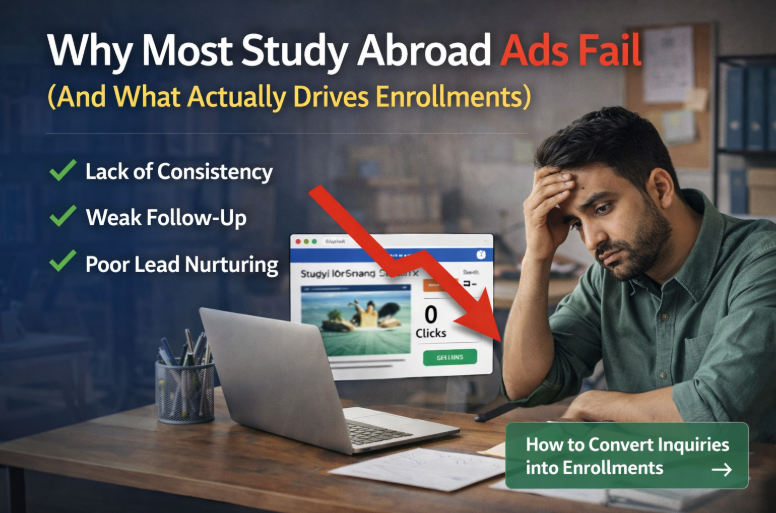
Most study abroad ads fail not because of poor creatives or low budgets, but because they operate in isolation — without a structured funnel, without a clear follow-up system, and without a strategy that aligns with how students actually make decisions.
If you want consistent enrollments, your focus cannot remain limited to generating leads. It must shift toward building a system that systematically converts those leads into committed students.
The Real Problem Behind Underperforming Ads
Across the industry, there is a common assumption that poor performance is simply a result of weak creatives or insufficient ad spend.
However, the deeper issue lies elsewhere.
Most study abroad businesses today are not struggling to generate inquiries — they are struggling to build an effective lead conversion system that turns those inquiries into actual enrollments.
Despite investing in multiple advertising channels, many consultants experience a disconnect between lead volume and actual admissions. This gap exists because there is no structured process guiding the student from initial interest to final decision.
Understanding How Students Actually Decide
Before attempting to improve performance, it is essential to understand how students evaluate their options and make decisions.
A typical journey consists of four stages:
- Attention — discovering opportunities
- Consideration — comparing countries and universities
- Evaluation — assessing trust and outcomes
- Action — applying and enrolling
Most consultants focus heavily on visibility, yet the real conversion happens beyond that stage.
Ads may generate attention, but systems ultimately drive decisions — which is why a structured ad funnel strategy for study abroad becomes essential.
Why Most Study Abroad Ads Fail to Convert
The failure of ads is rarely due to a single issue. Instead, it is a combination of small inefficiencies across the entire journey.
1. Broad Targeting Without Strategic Intent
When communication attempts to appeal to everyone, it fails to resonate with anyone. This weakens your overall student lead generation system and results in low-quality inquiries.
2. Repetitive and Undifferentiated Messaging
Generic messaging such as “Study in UK” or “No IELTS Required” has become saturated, making it difficult for students to differentiate between consultants.
3. Absence of a Structured Funnel
Leads are collected, but there is no defined admissions funnel for consultants that guides them toward a clear decision.
4. Delayed or Inconsistent Responses
A lack of speed reduces engagement significantly. A well-designed lead response system for students can dramatically improve first interactions and retention.
5. Lack of Trust-Building Mechanisms
Students are making high-stakes decisions. Without a strong trust-building strategy for student admissions, conversions naturally remain low.
A Structured Approach to Fixing Ad Performance
Step 1 — Redefine the Value Proposition
Rather than relying on generic calls to action, your messaging should communicate a clear and tangible outcome for the student.
Offering a personalized shortlist, structured roadmap, or financial clarity increases both engagement and intent.
Step 2 — Build a Funnel That Supports the Ad
An advertisement must connect to a broader system that captures, qualifies, and nurtures leads.
Without this, campaigns remain isolated and ineffective.
Step 3 — Prioritize Response Speed
Speed is a critical factor in determining conversion success. Responding quickly builds trust and positions your brand as reliable and professional.
Step 4 — Implement a Consistent Nurturing Process
A well-defined lead nurturing strategy for study abroad ensures that students receive continuous value throughout their decision-making journey.
This includes:
- Comparisons
- Budget clarity
- Visa guidance
- Step-by-step support
💬 Strategic Insight
If your ads are generating inquiries but not conversions, the issue is not visibility — it is the absence of a system that supports the journey.
Step 5 — Introduce Personalization
Segmenting leads based on preferences, financial capacity, and timelines is a fundamental part of an effective student segmentation strategy.
Step 6 — Build Trust Before Driving Decisions
A strong trust-building strategy for student admissions involves transparency, real success stories, and consistent guidance.
Trust reduces hesitation and accelerates decision-making.
Step 7 — Use Structured Urgency
Deadlines, visa timelines, and scholarship cutoffs help move students toward action without creating unnecessary pressure.
📊 Observations from Industry Experience
Across multiple campaigns and systems:
- Faster responses improve engagement significantly
- Structured nurturing increases interaction
- Personalization improves enrollment outcomes
Ultimately, success depends on a well-designed student conversion strategy, not just advertising efforts.
Step 8 — Balance Automation with Human Interaction
A well-implemented automation system for student leads ensures consistency while allowing human interaction to handle critical decision stages.
Common Strategic Mistakes
- Running ads without a funnel
- Delayed responses
- Over-promising outcomes
- Ignoring follow-ups
- Lack of tracking and optimization
Shift from Ads to Systems
If your goal is sustainable growth, your study abroad marketing strategy must evolve beyond ad optimization and move toward building a complete conversion ecosystem.
A combination of:
- Funnel clarity
- Response speed
- Lead nurturing
- Personalization
- Trust-building
creates a predictable and scalable system for enrollments.
If your ads are generating leads but not enrollments, it is time to focus on the system behind them.
👉 With the right infrastructure — like the
Edigibrands EdTech Product — you can turn inquiries into consistent admissions and build long-term growth.